Author: Blogger

  • How Banks Are Strengthening Legal, Compliance and HR with Digital Document Management

    In banking, information is not just important—it is critical. Legal documents, board records, regulatory filings and employee data must be accurate, secure and instantly accessible.

    Yet many banks continue to manage these records across physical files, shared folders and email trails. The result is predictable—delays, compliance risks and operational inefficiencies.

    This is where a Document Management and Workflow solution makes a measurable difference.

     

    A detailed view of a classic bank building facade with ornate Corinthian columns.

    Bringing Control to Legal and Secretarial Functions

    Legal and Secretarial departments in banks handle some of the most sensitive and high-value documents—contracts, litigation files, board resolutions and compliance records.

    With a digital system in place:​

    • Documents are centrally stored and easy to retrieve
    • Access is controlled based on roles and responsibilities
    • Version history is maintained, avoiding confusion
    • Audit trails ensure complete transparency

    This creates a strong foundation for compliance, governance and faster decision-making.

    From Fragmented Records to Structured Information

    Instead of searching through cabinets or multiple systems, teams can:

    Retrieve documents instantly using simple search
    Track changes and approvals without manual follow-up
    Respond faster to regulatory queries and audits
    Ensure that no document is lost, duplicated or outdated

    The shift is not just operational—it directly reduces risk.

    Scaling Across Departments: The Next Step

    One of the biggest advantages of a Document Management and Workflow solution is scalability.

    After successfully implementing the system in Legal and Secretarial functions, many banks are now extending its usage to other departments such as HR.

    HR Benefits Include:
    • Secure management of employee records
    • Faster onboarding and verification
    • Improved compliance with statutory requirements
    • Easy access to documents without physical dependency

    The same system adapts seamlessly—without the need for separate solutions.

    Why Banks Are Making the Shift
    • Stronger compliance and audit readiness
    • Secure handling of sensitive information
    • Faster access to critical documents
    • Reduced dependency on physical storage
    • Improved efficiency across departments
    • A single, scalable platform for the entire organisation

    Call to Action: A Future-Ready Approach​

    In an environment where compliance requirements are increasing and response times are shrinking, banks need systems that are reliable, secure and scalable.

    A Document Management and Workflow solution does exactly that—bringing structure to information and confidence to operations.

    If your organisation is still managing critical records manually, this is the right time to rethink your approach.


    Get in touch with us today.


  • Why Hospitals in India Are Moving to Digital Document Management Systems

    Why Hospitals in India Are Moving to Digital Document Management Systems

    Hospitals today handle an overwhelming volume of documents every single day. From patient records and consent forms to billing documents and HR files, information flows constantly across departments.

    Yet, many hospitals still rely heavily on paper.

    This creates delays, increases risk and makes compliance more difficult—especially when standards like  NABH accreditation  require accurate, accessible and well-maintained patient records.

    This is where a Document Management and Workflow solution  becomes essential.

    Healthcare worker wearing scrubs and face mask writing in an office setting, surrounded by documents.

    Patient Record Management Made Simple

    Maintaining patient records is not just an operational need—it is a regulatory requirement. With a digital system in place:

    • Patient files are securely stored and instantly accessible
    • Records can be retrieved in seconds during treatment or audits
    • There is no risk of files being misplaced or damaged
    • Complete history is available at the point of care

    This directly supports NABH compliance while improving patient care and response time.

    Beyond Medical Records: A Hospital-Wide Impact

    While patient records are the starting point, the benefits extend across departments.

    Finance and Accounts
    • Faster access to billing records and insurance documents
    • Smooth audit processes with complete traceability
    • Reduced delays in claim processing and approvals
    HR Department
    • Digital employee records with secure access
    • Faster onboarding and verification
    • Easy compliance with statutory requirements
    Administration and Operations
    • Centralised storage of contracts, approvals and correspondence
    • Reduced dependency on physical storage space
    • Better coordination across departments
    Workflow Automation Brings Speed and Control

    A document system combined with workflow automation ensures that processes move without delays.

    Files are routed automatically for approvals
    No manual follow-ups or lost paperwork
    Every action is tracked and recorded
    Teams stay aligned without constant coordination

    Key Advantages for Hospitals

    • Instant document retrieval across departments
    • Strong compliance and audit readiness
    • Elimination of physical file storage
    • Protection from fire, water damage or ageing
    • Improved efficiency and reduced administrative workload
    • Better patient experience due to faster response times

    A Smarter Way Forward

    Hospitals are under constant pressure to improve care while managing costs and compliance. A Document Management and Workflow solution helps achieve all three—by bringing structure, speed and security to information management.

    If your hospital is still dependent on paper, the question is not if you should go digital, but when.

    Call to Action: Digital transformation starts with better document management.

    Reduce delays, eliminate misplaced files and streamline workflows with a secure digital document management system. Get in touch to see how your hospital can go paperless.

    Get in touch with us today and see what your Hospital could look like with the right system in place.

  • How a Mumbai Asset Reconstruction Company Cut Delays and Took Control of Operations

    How a Mumbai Asset Reconstruction Company Cut Delays and Took Control of Operations

    Introduction: The Hidden Cost of Broken Processes

    In asset reconstruction, time is money. Every delay in approvals, every misplaced document and every manual follow-up directly impacts recovery timelines.

    A Mumbai-based asset reconstruction company came to us with a familiar problem. Their business was growing, but their processes weren’t keeping up.

    They weren’t lacking expertise. They were being held back by inefficient systems.

    Close-up of hands typing on a laptop in a cozy indoor cafe setting.

    The Reality: When Systems Slow Down Your Business

    Before working with us, their operations looked like this:

    Critical documents spread across emails, shared drives and local systems

    Approval processes dependent on manual coordination

    No real-time visibility into case status

    Teams constantly following up instead of moving work forward

    Here’s the thing. These aren’t small inefficiencies.

    • They compound quickly.
    • Delays increase. Compliance risks grow. Productivity drops.
    • And most importantly, opportunities are lost.
    The Shift: From Chaos to Control

    They needed more than a patchwork fix. They needed a system designed for how their business actually works.

    We implemented a unified content management and workflow platform tailored to their operations.

    What changed immediately:
    Centralised Information

    Every document, case file and record moved into a single, structured system. No duplication. No confusion. No time wasted searching.

    Automated Workflows

    Approvals were no longer dependent on emails or manual follow-ups. Each process was clearly defined, triggered automatically and tracked at every step.

    Complete Visibility

    Leadership could now see exactly where each case stood, where delays were happening and how teams were performing.

    And most importantly, opportunities are lost.

    The Impact: Measurable Business Gains

    This wasn’t just a system upgrade. It was an operational transformation.

    • Turnaround times dropped significantly
    • Approval cycles became faster and more consistent
    • Compliance improved with built-in audit trails
    • Teams reclaimed hours previously lost to coordination and tracking

    What this really means is simple. They stopped reacting and started operating with control.

    Why This Should Matter to You

    If your organisation relies on documents, approvals and structured processes, this isn’t a niche problem. It’s likely already affecting your bottom line.

    Most companies don’t realise how much inefficiency is costing them until they fix it.

    The difference between manual and automated workflows isn’t incremental. It’s exponential.

    What You Gain with the Right System
    • Faster decision-making
    • Reduced operational risk
    • Higher team productivity
    • Scalable processes that grow with your business

    And just as important, clarity across your organisation.

    The Bottom Line

    Your team shouldn’t be chasing documents or approvals.

    They should be closing cases, making decisions and driving outcomes.

    If your current systems are slowing you down, the cost isn’t just operational. It’s strategic.

    Call to Action: Let’s Fix What’s Slowing You Down

    We help organisations take control of their content, workflows and operations.

    If you’re dealing with delays, inefficiencies or lack of visibility, it’s time to address the root cause.

    Get in touch with us today and see what your business could look like with the right system in place.

  • The Year That Was — A Thank You Worth Saying Out Loud

    Flat lay of dried flowers surrounding a smartphone displaying a thank you message.

    Some years blur into the next. This one didn’t.

    As we closed our books yesterday, there was a pause – the kind that doesn’t come from exhaustion but from something closer to gratitude. Because when you look back honestly at twelve months of work, what you see isn’t revenue lines or quarterly targets. You see faces. Conversations. The moments where things could have gone sideways and didn’t, because the right people were in the right place.

    Our customers kept us honest. They pushed us to be better not through complaints but through expectations – the quiet, steady kind that says “we believe you can do this”. That belief is not something you earn once. You earn it every single day and we don’t forget that.

    Our vendors and partners brought something harder to quantify than capability – they brought reliability. The kind where you don’t have to follow up twice, where a handshake still means something. In a world that moves fast and forgives little, that sort of consistency is genuinely rare.

    To our bankers — thank you for seeing the bigger picture when the view from the ground gets complicated. Financial partnerships are easy in good times. The ones that matter show up in the complicated ones.

    And our people. Every organisation says its team is its greatest asset; fewer actually mean it. We do. This year asked a lot. It was met with more.

    None of what we achieved was inevitable. It was chosen – by every person who showed up, stayed the course and gave a little more than was asked of them.

    That’s the year that was. And it was a good one.

    Here’s to building the next one together.

  • Silence in Critical Care: How Wireless Calling Systems Improve ICU Communication

    The Intensive Care Unit is not just another hospital department. It is where every second matters. Patients are critical, families are anxious and nurses must balance clinical focus with constant coordination.

    In such a sensitive space, communication must be precise and calm.

    The Reality in Many ICUs

    In most hospitals today, when a nurse needs to call a patient’s attendant from the waiting area, the process is surprisingly manual. The nurse informs the security guard outside. The guard then calls out the patient’s name or bed number loudly in the corridor.

    The result?

    Noise. Confusion. Repeated announcements. Emotional tension.

    For families already under stress, this adds to anxiety.

    A Structured and Silent Alternative
    • With a wireless calling system, the process becomes simple and dignified.
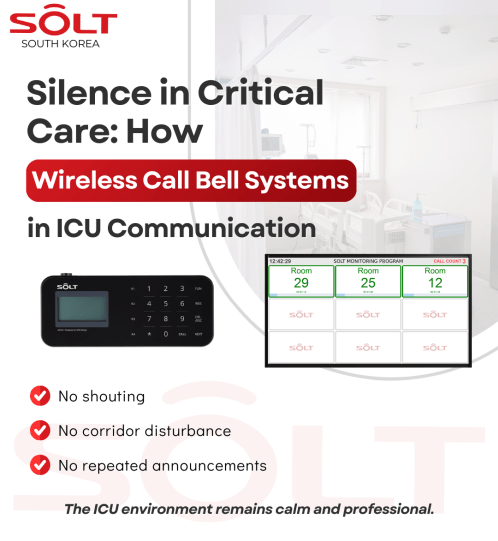
    • From the nurse station keypad, the nurse enters the patient’s bed number. Instantly, that number appears on a display screen in the waiting area. The attendant sees it and proceeds inside.
    • No shouting.
    • No corridor disturbance.
    • No repeated announcements.
    • The ICU environment remains calm and professional.
    Supporting Clinical Workflow
    • Inside the ICU, wireless call points allow nurses to communicate efficiently with support teams. Separate alerts can be configured for housekeeping, maintenance or urgent assistance.
    • The system operates on safe 433 MHz RF technology and does not depend on Wi-Fi networks, ensuring stable communication in critical care areas.
    Faster Installation, Greater Flexibility
    • ICUs are often upgraded in phases. A wireless system avoids the complexity of cabling and civil work. It can be deployed quickly without disrupting patient care.
    • As beds increase or layouts change, the system scales easily.
    The Bigger Picture
    • In the ICU, silence is not just comfort. It is control.

    • Wireless calling systems bring order to communication between nurses, security staff and families. They reduce noise, improve coordination and create a more composed environment during critical moments.

    To modernise ICU communication, call +91 9321064487.
  • Quiet Support When It Matters: Wireless Call Systems in Day Care Centres

    Day care centres in hospitals are unique spaces. Patients come in for chemotherapy, dialysis and other scheduled treatments. They may spend several hours connected to equipment, often feeling weak, anxious or uncomfortable.

    During these sessions, even small discomforts require timely assistance.

    Communication must be simple, immediate and reassuring.

    The Need for Immediate Assistance
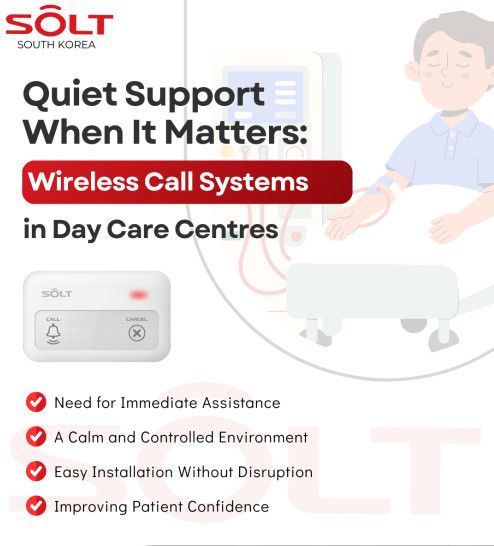
    • Patients undergoing chemotherapy or dialysis cannot easily get up to call a nurse. Some may feel dizzy. Others may experience sudden reactions or discomfort.
    • A wireless call bell system allows the patient to press a button and alert nursing staff instantly. The alert reaches the nurse station or designated display panel without delay.
    • Help is summoned quietly and efficiently.
    A Calm and Controlled Environment
    • Day care units must maintain a peaceful atmosphere. Loud buzzers or shouting across the room add to patient anxiety.
    • Wireless systems provide silent alerts that are clearly displayed to the nursing team. Staff respond quickly without disturbing other patients.
    • The environment remains professional and reassuring.
    Easy Installation Without Disruption
    • Day care centres often expand gradually. Additional chairs or dialysis beds may be added over time.
    • A wireless call system operates on safe 433 MHz RF technology and requires no cabling. Call points can be installed or relocated easily without drilling walls or interrupting treatment schedules.
    • Maintenance is minimal and battery replacement cycles are predictable.
    Improving Patient Confidence

    For patients receiving repeated treatments, confidence in the system matters. Knowing that assistance is available at the press of a button reduces stress and improves overall experience.

    The Bigger Picture
    • In day care settings, care is not just clinical. It is emotional.
    • A reliable wireless call system ensures that when a patient needs support during treatment, help arrives promptly and quietly.
    To explore solutions for your day care centre, call +91 9321064487.
  • Dignity, Safety and Compliance: Emergency Call Systems for Accessible Toilets

    An accessible toilet is designed to provide independence. But independence must not come at the cost of safety.

    For persons with disabilities, a simple slip or moment of discomfort inside a toilet can quickly become a distressing situation. In such moments, calling for help should be immediate and effortless.

    That is why emergency call systems are critical.

    A Clear Regulatory Expectation
    • The Harmonised Guidelines and Standards for Universal Accessibility in India 2021 issued by the Ministry of Housing and Urban Affairs recommend emergency alarm systems in accessible toilets.
    • This places responsibility on hospitals, commercial buildings, educational institutions, malls and public facilities to ensure that every PWD toilet is equipped with a reliable emergency alert mechanism.
    • It is not merely good practice. It is a compliance requirement.
    How a Wireless System Works

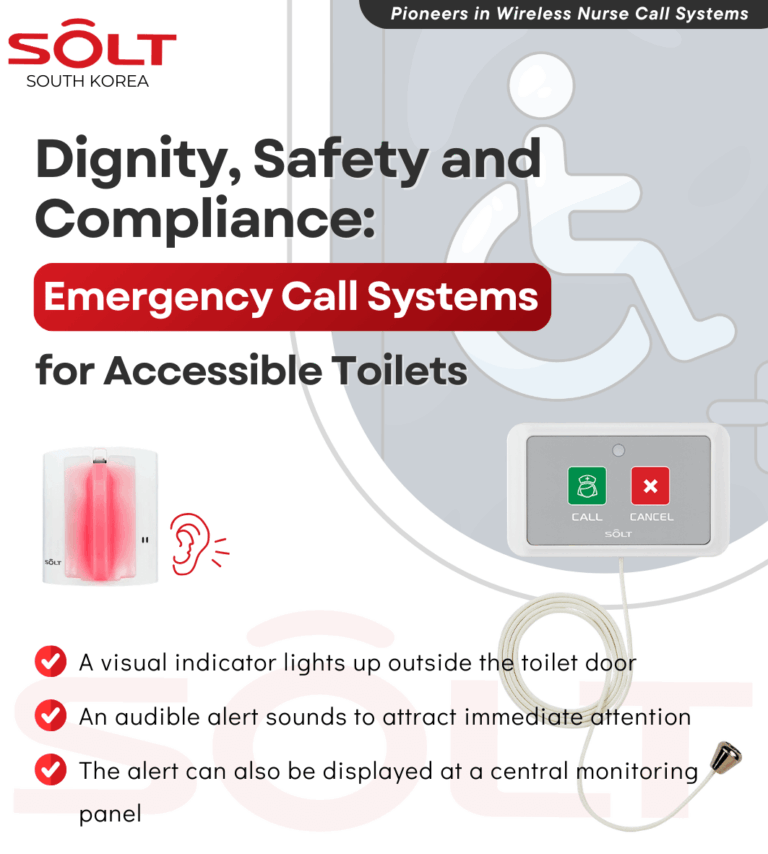
    Inside the accessible toilet, a wall-mounted emergency button or pull cord is installed within easy reach.

    When activated:

    • A visual indicator lights up outside the toilet door
    • An audible alert sounds to attract immediate attention
    • The alert can also be displayed at a central monitoring panel

    The light outside clearly identifies which cubicle requires assistance. The audio indication ensures that the alert is not missed in busy corridors.

    There is no need for the person inside to shout or knock repeatedly.

    Quick Installation Without Structural Changes

    Because the system operates on safe 433 MHz RF technology, no extensive wiring is required. It can be installed in new buildings or retrofitted into existing facilities with minimal disruption.

    Maintenance is low and battery replacement cycles are predictable.

    More Than Compliance

    An emergency call system in PWD toilets is not just about following guidelines. It is about dignity, reassurance and responsible design.

    When assistance is needed, help must be visible, audible and immediate.

    To equip your facility with compliant PWD toilet emergency call systems, call +91 9321064487.
  • Invest Once, Grow Anytime: The Future Ready Advantage of Wireless Systems

    A common hesitation among hospital planners is the fear that wireless nurse call systems may become outdated quickly. The belief is that wired systems feel “permanent” so they appear more future proof at first glance. 

    In reality the opposite is true.

    A wired system locks a hospital into the infrastructure of a single moment in time. Any renovation, new ward, layout change or upgrade means civil work, rewiring and disruption. That becomes expensive and slows down progress. 

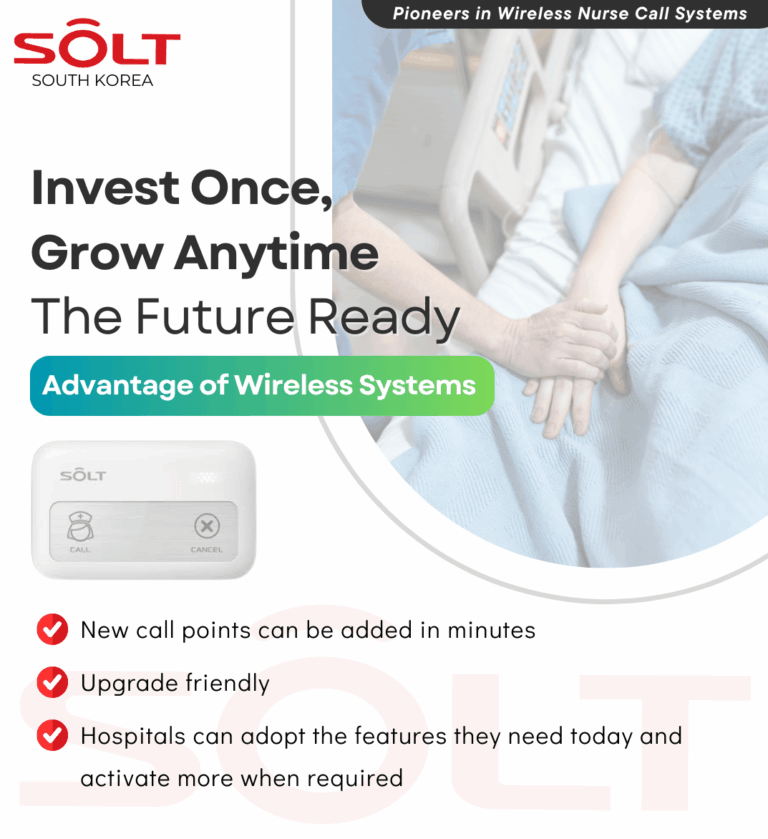
    A wireless nurse call system, however, is designed to grow with the hospital. New call points can be added in minutes, layouts can be changed without breaking walls and wards can be upgraded without shutting them down. When hospitals expand bed capacity or add day care units, emergency bays or speciality zones, the system adapts instantly. 

    Future readiness also means compatibility.

    Modern wireless systems support features such as Code Blue expansion modules, integration with PA systems, wearable alerts for staff on the move and optional add-ons like pressure mats for fall management. Hospitals can adopt the features they need today and activate more when required, without replacing the core system.

    Software configuration is another advantage. Settings, priorities and alert types can be changed as workflows evolve. A new nursing protocol does not mean a new system. 

    The future belongs to flexible, upgrade friendly systems that adapt without disruption. Wireless fits that need perfectly. 

    Interested? Call +91 9321064487 or email sales@rincon.co.in
  • The True Cost of Communication: Why Reliability is Your Biggest Saving

    Some believe wireless technology sacrifices performance for convenience. But what if the internal quality of the components was the only factor that mattered, guaranteeing reliable service for years? 

    Feature Highlight: South Korean Engineering and Unmatched Reliability

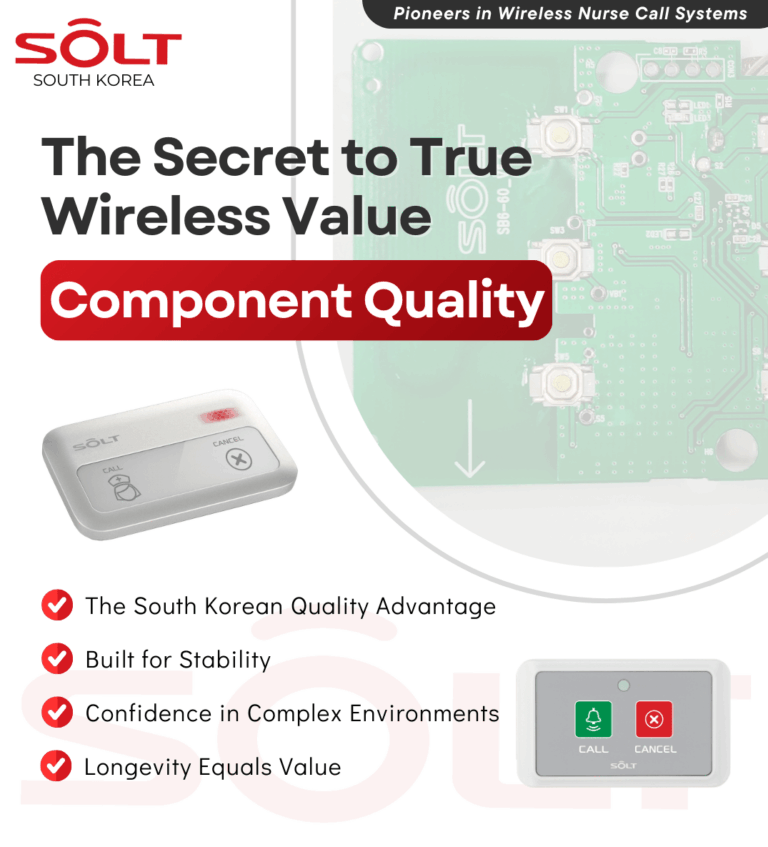
    SOLT Wireless Call Systems defy the myth that wireless means flimsy. Engineered and manufactured in South Korea using only the best electronic components, we ensure your communication system is a long-term asset, not a temporary fix. 

    1. The South Korean Quality Advantage : Our systems are built with world-class components, ensuring stability and signal integrity that cheap wireless solutions simply cannot match. This dedication to superior engineering maximises uptime and drastically reduces the risk of system failure. 

    2. Built for Stability, Not Speed : Reliability is our primary goal. By using top-tier internals, our systems maintain consistent performance, delivering instant alerts every time. This eliminates the “is it working?” anxiety associated with low-quality electronics. 

    3. Confidence in Complex Environments : A system is only as good as its weakest link. Because our components are military-grade reliable, SOLT solutions operate flawlessly even in large, complex facilities—from sprawling factories to multi-wing hospitals—proving their resilience where others fail. 

    4. Longevity Equals Value : Initial cost is insignificant compared to the cost of replacing an unreliable system after just a few years. By specifying a product built with world-class components, you are guaranteeing long-term operational excellence, making SOLT the smart, economical choice. 

    Interested? Call +91 9321064487 or email sales@rincon.co.in
  • Worried About Compliance? Wireless Nurse Call Systems Already Meet the Standards

    A common doubt among hospital decision makers is whether wireless nurse call systems meet the required standards for safety and performance. The assumption is that wired systems are more compliant because they are “traditional” and therefore more acceptable during audits. 

    The reality is very different.

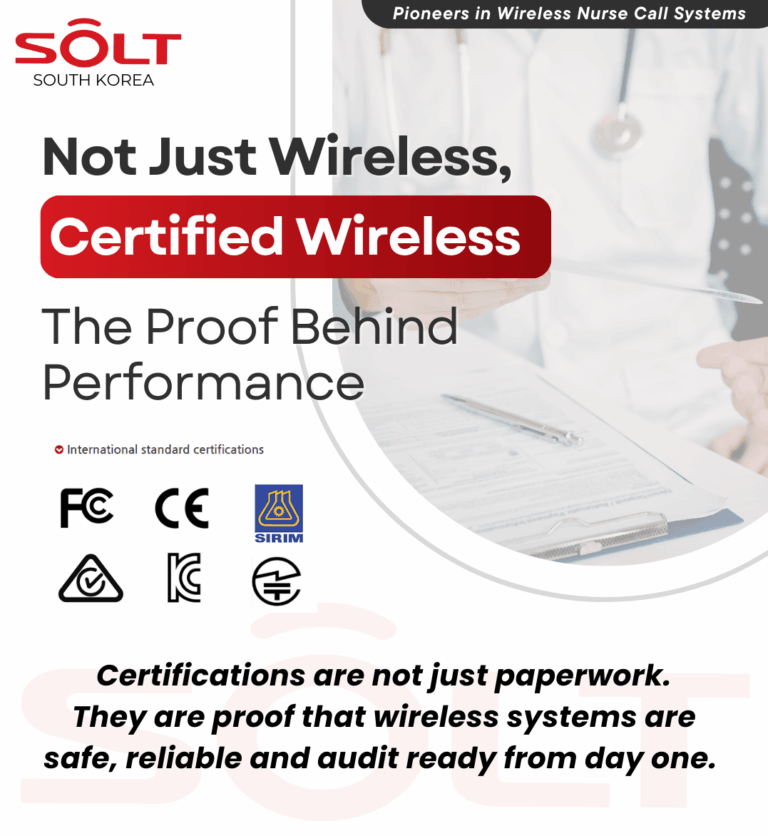
    Modern wireless nurse call systems come with international certifications that wired systems do not even require. Products designed for global healthcare markets carry CE and FCC certifications, ensuring they meet strict benchmarks for radio safety, electromagnetic compatibility and product reliability. These are the same standards followed by medical devices used worldwide. 

    For the Indian market, wireless systems operate on frequencies approved by the Government and come with WPC certification, confirming that the equipment is safe to use in hospitals without interfering with medical devices. 

    Compliance does not end there. Hospitals working towards NABH accreditation must demonstrate clear safety practices. This includes accessible call points at every bed, toilet points for immobile patients and a Code Blue system that alerts staff instantly in an emergency. A good wireless system meets all these requirements and simplifies compliance because installation is easy and upgrades do not require major civil work. 

    For hospitals that do not have Code Blue, a stand-alone wireless Code Blue solution can be deployed quickly without shutting down the ward. This allows hospitals to meet audit requirements even when their wired system cannot support upgrades. 

    Certifications are not just paperwork. They are proof that wireless systems are safe, reliable and audit ready from day one. 

    Interested? Call +91 9321064487 or email sales@rincon.co.in