Blog

  • Serious Healthcare Needs Serious Build Quality – Here Is What To Look For

    One common misconception about wireless nurse call systems is that they are “fragile” compared to wired systems. Many believe that because they run on small batteries or have no cables, they cannot match the durability of wired call points. 

    The truth is very different.

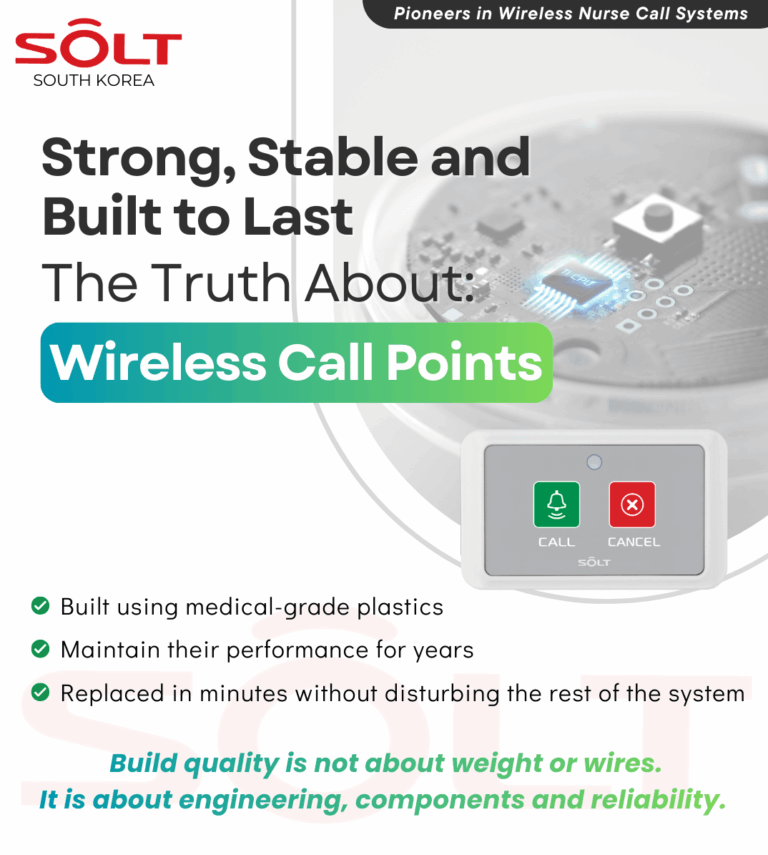
    A high-quality wireless system like SOLT is engineered for demanding hospital environments. The call points are built using medical-grade plastics, sealed keypads and reinforced internal components. These devices are designed to survive daily use in wards, ICUs, OPDs and even high-traffic areas such as emergency bays. 

    Build quality matters because call points are pressed hundreds of times every day. Cheap systems develop loose buttons or contact failures. Good wireless systems maintain their performance for years because of better PCBs, stronger switches and tighter quality control

    There is also one practical advantage. If a wired call point fails, the entire line may need to be checked which means downtime and inconvenience. A wireless call point can be replaced in seconds without disturbing the rest of the system. 

    A well-built wireless call point will outlast a cheaper wired unit and will do so with less maintenance, less downtime and less frustration for nurses and patients. 

    • ” Build quality is not about weight or wires. It is about engineering, components and reliability. ”
    Interested? Call +91 9321064487 or email sales@rincon.co.in
  • Compliance Matters: How SOLT Wireless Nurse Call Systems Meet NABH & JCI Standards

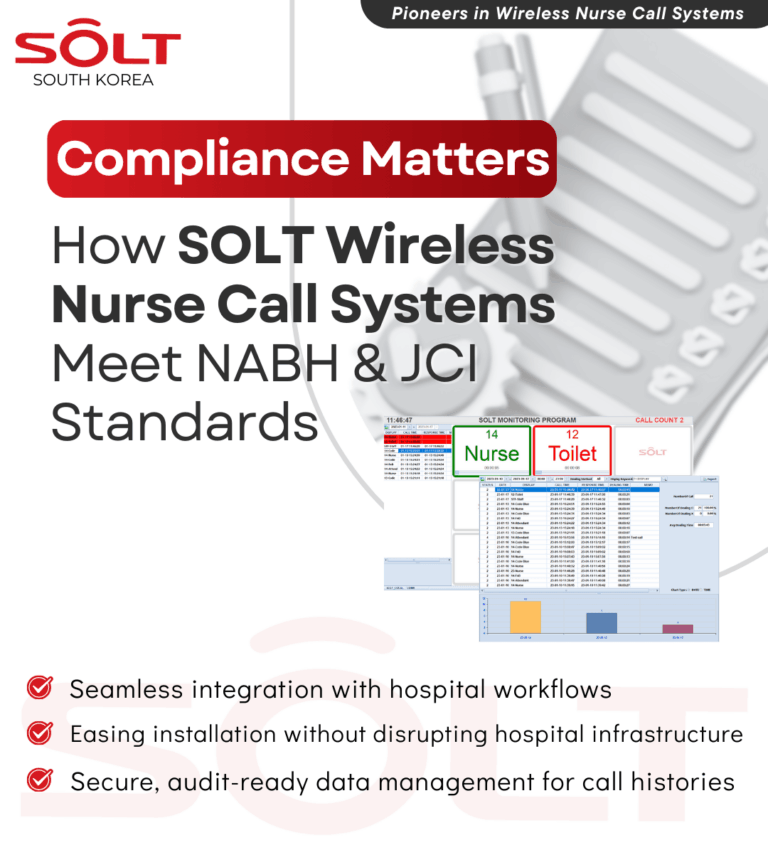
    Meeting stringent healthcare compliance benchmarks like NABH (National Accreditation Board for Hospitals & Healthcare Providers) and JCI (Joint Commission International) is essential for modern hospitals. These standards demand reliable, quick, and safe communication solutions—and SOLT wireless nurse call systems are designed to exceed these compliance requirements. 

    Our systems support:
    • Immediate patient-to-staff alerts to ensure rapid response times
    • Secure, audit-ready data management for call histories, key for accreditation
    • Seamless integration with hospital workflows preserving privacy and care quality
    • Robust reliability even in complex hospital environments, meeting safety mandates
    • Wireless architecture easing installation without disrupting hospital infrastructure
    • With SOLT, hospitals achieve compliance while enhancing efficiency and patient safety—all without the hassle of complex wiring.
    Interested in ensuring your hospital is ready for NABH & JCI audits? Call +91 9321064487 or email sales@rincon.co.in.
  • The True Cost of Communication: Why Wireless Maintenance is the Smart Investment

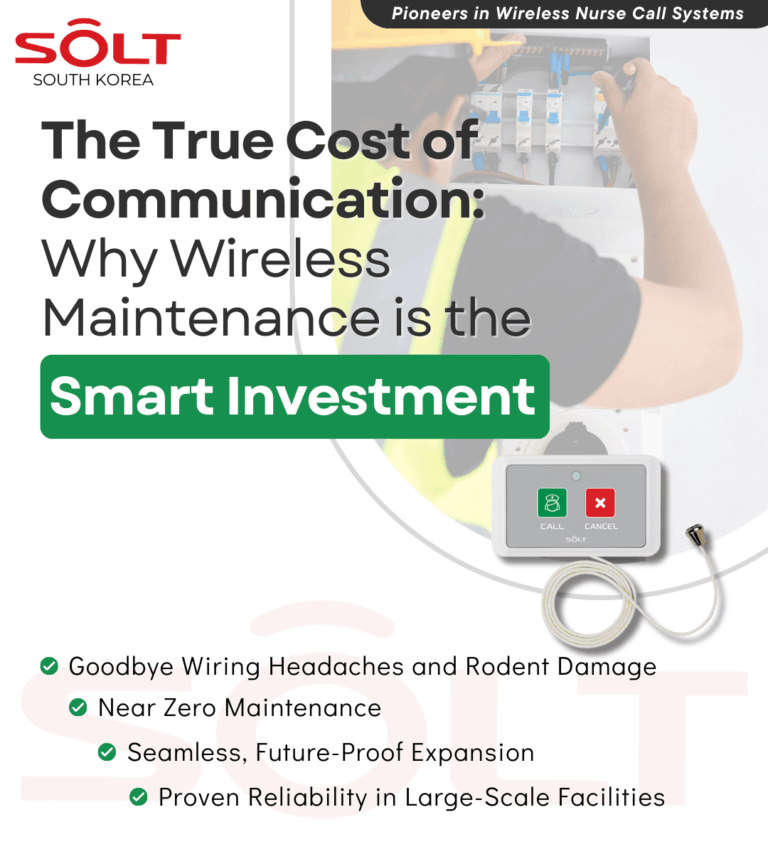
    Are you worried that a high-tech wireless call system will mean complex, constant maintenance costs? Think again. The most significant savings in any communication system are found not in the initial purchase, but in the lifetime cost of ownership. 

    Feature Highlight: Minimal Maintenance, Maximum Uptime

    SOLT Wireless Call Systems are engineered in South Korea for maximum durability and minimal fuss, directly addressing the key pain points of traditional wired infrastructure: 

    1. Goodbye Wiring Headaches and Rodent Damage: 

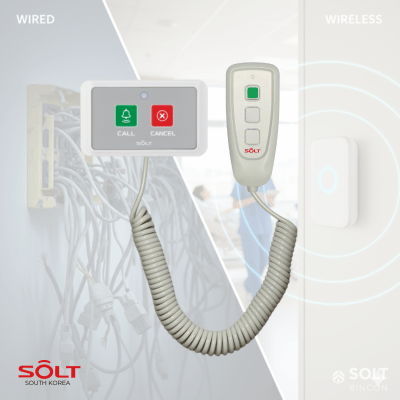
    Wired systems are instantly vulnerable. Damage to a single, inaccessible cable—whether from renovation work or rodent activity—can take hours or days to locate and fix. SOLT systems eliminate kilometres of complex wiring, removing the most common point of failure and ensuring uninterrupted service.

    2. Near Zero Maintenance : 

    Our call points feature incredibly long battery life, often lasting 18 to 24 months with regular use. Battery replacement is simple, taking seconds, and is guided by low-battery alerts, allowing facility managers to schedule changes efficiently, not react to emergencies. 

    3. Seamless, Future-Proof Expansion :

    When your facility grows, your communication system should too. Our repeaters offer a 360-degree signal field, making coverage expansion as simple as placing a new device. There is no need for structural work, allowing you to easily add call points exactly where needed, when needed.

    4. Proven Reliability in Large-Scale Facilities

    SOLT solutions are not just for small sites. Our technology operates flawlessly in some of the largest, most complex facilities, demonstrating that reliability is built into the product, not reliant on vulnerable cabling. 

    Interested? Call +91 9321064487 or Email sales@rincon.co.in
  • MythBusted: Wireless Call Bell Coverage – SOLT’s Design Advantage

    Ever heard that wireless call bell systems simply can’t match the coverage of wired ones? This myth might be costing you more flexibility, convenience, and peace of mind than you realise. 

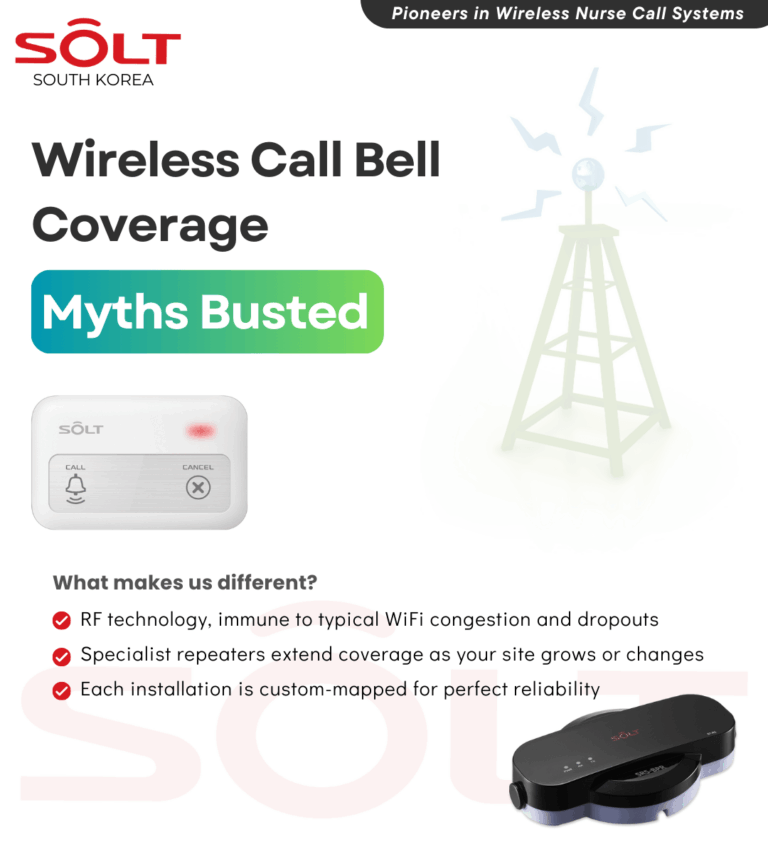
    At SOLT, our wireless call bells run on reliable RF (radio frequency), not on WiFi. Unlike WiFi-based solutions that can struggle with walls and interference, our RF network uses 360° repeaters that blanket even the most complex facilities in seamless coverage. No dark spots. No dead ends.

    It’s not just a promise—it’s proven. We have successfully deployed the system in vast hospitals, luxury residences, large offices, and major construction sites. Before every project, our team carries out a detailed site survey to guarantee every area—no matter how remote or tricky—is always covered. 

    What makes us different?
    • RF technology, immune to typical WiFi congestion and dropouts
    • Specialist repeaters extend coverage as your site grows or changes
    • Each installation is custom-mapped for perfect reliability
    • Real case studies from sprawling buildings across India
    • Full peace of mind—our coverage is as robust as any wired system, with extra flexibility
    • Don’t get swayed by old thinking. SOLT makes wireless mean more, not less.
    Interested? Call +91 9321064487 or Email sales@rincon.co.in
  • Think Wireless Costs More? Here Is the Truth About Hospital Savings

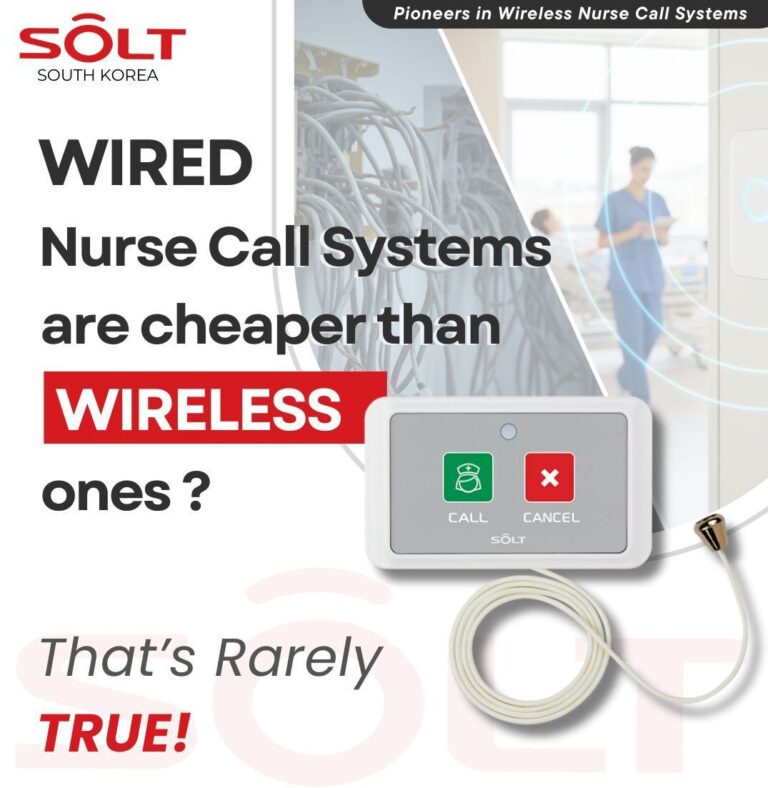
    Hospitals often assume wireless nurse call systems are more expensive than wired ones. This belief usually comes from comparing only the cost of the device and not the full cost of installation, labour and ongoing maintenance.

    Here is the real picture.

    A wired system may look cheaper on paper, but the hidden expenses add up fast. Hospitals must run conduits, chase walls, pull cables, rebuild partitions and repaint rooms. When work happens in live patient areas, the cost rises even further. The cabling itself is not the biggest expense. It is the labour and disruption that make wired systems expensive.

    With wireless systems the story changes completely. There is no cabling, no wall cutting and no room shutdowns. Installation is quick and clean which means wards remain functional. Labour costs drop sharply and projects finish faster. This alone makes wireless systems significantly more cost efficient.

    The savings continue after installation. A faulty wired call point often needs technical investigation from end to end which increases downtime and service cost. A wireless call point can be replaced in seconds without disturbing the rest of the setup. Maintenance becomes predictable and cheaper.

    When hospitals evaluate the full lifecycle cost, wireless systems almost always prove to be the more economical choice. The idea that they are expensive is not just outdated, it is inaccurate.

    Interested? Call +91 9321064487 or Email sales@rincon.co.in
  • Why Battery Life Should Never Stop You from Choosing Wireless

    Many hospitals avoid wireless nurse call systems because they assume the batteries will not last and maintenance will become a burden. Competitors often fuel this fear by claiming that battery changes are frequent, costly and disruptive.

    Here is the good news. None of it is true.

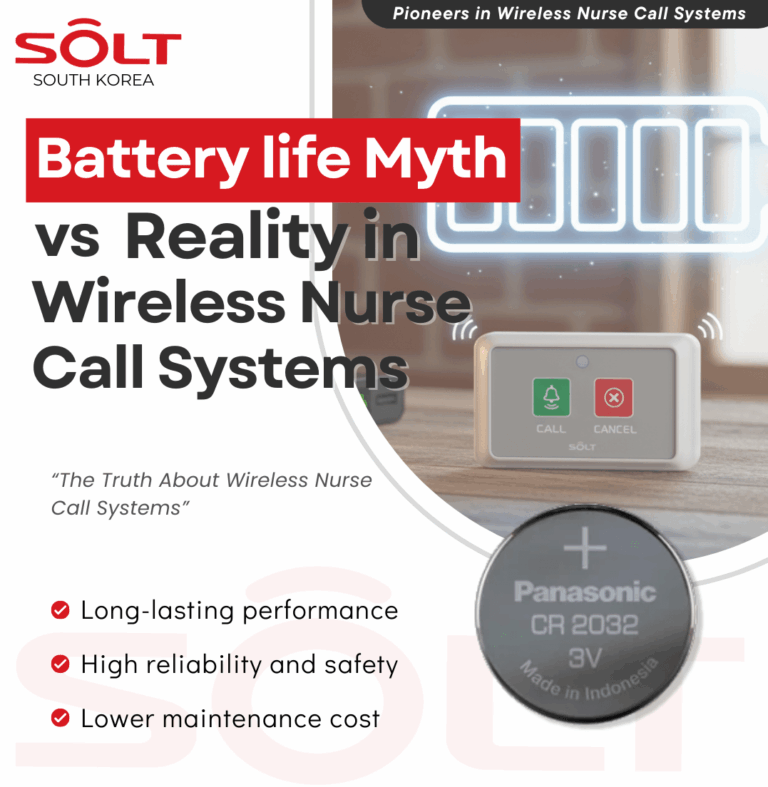
    SOLT Wireless Call Bell Systems are designed to run for 18 to 24 months on simple coin batteries, even with an average of 15 presses a day. These batteries are inexpensive, easy to replace and widely available. No specialist tools, no complex procedure, no technician needed.

    This long battery life is possible because the system uses RF technology which consumes very little power. It is built for the real world of busy wards where reliability matters more than anything. Hospitals that have switched to wireless often find their maintenance workload going down instead of up.

    What this really means is simple.
    • No wiring headaches
    • No false claims about heavy maintenance
    • No hidden costs
    • No downtime waiting for electricians

    Wireless is not just flexible and modern. With long life coin batteries it is also one of the most cost effective nurse call solutions available.

    Interested? Call +91 9321064487 or Email sales@rincon.co.in
  • Reblog: How Artificial Intelligence improves ECM

    According to Gartner, more than 85% of CIOs plan to integrate artificial intelligence into their document system by 2026. The association of Smart ECM and AI mark a major breakthrough: enhanced automation, increased data reliability and reinforced compliance. ECM AI transform document management by reducing processing times, securing exchanges and making access to information more reliable.

    For an IT department, HR director, CFO or DGS, the objective is not to “do AI”, but to make data reliable and improve document processes.

    The heart of the matter: Data before AI, that is, documentary quality before AI adoption.

    How does Artificial Intelligence intervene within an ECM?

    Where the AI excels

    In an intelligent ECM, AI intervenes at all levels: capture (OCR/ICR), enrichment (extraction, standardization), semantic classification (NLP), vector search, automation (workflows) and assistance (LLM agents).

    According to IDC 2024, these modules can generate up to 30% more document productivity.

    Above all, reliable data: the condition for AI success

    High-performance Artificial Intelligence is based on up-to-date, versioned documents with consistent metadata.

    The RAG (Retrieval-Augmented Generation) approach uses ECM as a structured knowledge base to produce contextualized and traceable responses.

    To prepare your Electronic Content Management for the integration of AI, you must first make metadata, access rights and life cycles reliable.

    Efalia ECM Focus

    Efalia takes an Data-first approach : centralization, standardization, selective vectorization.

    Artificial Intelligence is integrated into the documentary engine, not added afterwards. It intervenes at each stage of the life cycle: capture, classification, research, compliance.

    This data structuring can improve the relevance of AI responses, reduce latency and eradicate hallucinations.

    What Artificial Intelligence brings to ECM

    Strengthening OCR with the addition of ICR

    The ICR reads various manuscripts and forms.

    This technology makes upstream automation reliable, especially in HR or accounting departments, by eliminating re-entry errors.

    A Forrester 2024 study confirms that adopting ICR increases data quality and document processing speed.

    Intelligent and automatic ranking based on semantics

    NLP algorithms detect the type (contract, invoice, PV, amendment) and the entities (third parties, people, references).

    ECM AI classifies documents by semantic analysis and similarity, allowing dynamic archiving and better document governance.

    Better security and the fight against document fraud

    AI models identify inconsistencies and anomalies: duplicates, falsifications, missing signatures.

    According to Forrester 2024, ECM AI solutions contribute to reducing document fraud and strengthening the traceability of exchanges.

    Artificial Intelligence enriches audit logs, reinforces GDPR and ISO 27001 compliance, and guarantees evidentiary traceability.

    Improving the time and relevance of research

    Thanks to theenhanced semantic search, users find “the right document in the right place” instantly.

    IDC reports that businesses equipped with intelligent ECM significantly improve productivity related to document research.

    The results are contextualized and sourced, reinforcing reliability and trust in the data.

    Automating Electronic Content Management with Artificial Intelligence

    ‍Agent-driven workflows: from reception to validation

    AI agents orchestrate the reception, analysis, classification, and validation of documents. The workflow is executed automatically, reducing the human load and homogenizing the deadlines. According to Efalia, this automation offers an average ROI of +404% over three years.

    IS integrations and IT supervision

    Documentary AI is integrated with ERP, HRIS, accounting and collaborative tools. The CTO maintains supervision: logs, compliance, alerts, quotas. Efalia also indicates —40% paper costs and +90% automatic compliance (after implementing ECM software coupled with AI).

    ‍Pragmatic road map

    Choose a priority use case (HR, suppliers, public procurement), clean up the documentary fund, configure the capture, then iterate.

    Transform your ECM with AI, secure each stage, measure the gains and capitalize on the most efficient workflows.

    ECM and Artificial Intelligence: The Efalia solution

    Efalia ECM + IA: “data before AI”, vectorization, metadata, governance

    Efalia ECM centralizes and secures documents by integrating AI natively.

    It is ECM software coupled with AI capable of automatically extracting, classifying, indexing, and searching for content.

    The results announced highlight a measurable increase in productivity and compliance (Efalia documentation).

    ‍Business use cases

    HR department: automation of the employee file, analysis of amendments and HR policies. 

    Chief Financial Officer: automatic reconciliation of invoices and purchase orders, reduction of errors. 

    Operations Director or Manager: complete traceability of public contracts and sensitive decisions, reinforced GDPR compliance.

    Architecture choice: SaaS/On-Prem/Sovereignty

    Efalia offers a flexible architecture, adapted to the sovereignty requirements of public and private organizations.

    Artificial Intelligence can be deployed locally or via cloud models, depending on security policy and data governance.

    ECM AI : choice criteria, road map and risks to avoid

    ‍Selection criteria

    Extraction, indexing, hybrid search, security (encryption, MFA), interoperability and traceability are the foundations of intelligent ECM.

    A prior audit of documentary quality significantly reduces the risks of non-compliance (Source Forrester).

    ‍Risks to avoid

    Obsolete data, poorly managed permissions, lack of logging, uncontrolled vectorization.

    According to Forrester and IDC studies, 70% of AI failures come from a lack of document governance rather than the algorithm.

    ‍👉 The 5 foundations to be laid for the successful integration of AI into ECM in 2025

    ‍FAQ — AI & ECM

    No, it increases it: hybrid text + vector index and query reformulation.

    Through traceability, minimization and documentary governance.

    Useful reference: CNIL — IA and personal data.

    Forrester and IDC point to significant gains in productivity and error reduction through intelligent automation.

    Because Efalia focuses on documentary quality above all, guaranteeing reliable, traceable and sovereign AIs.

    No, it increases it: hybrid text + vector index and query reformulation.

    Through traceability, minimization and documentary governance.

    Useful reference: CNIL — IA and personal data.

    Forrester and IDC point to significant gains in productivity and error reduction through intelligent automation.

    Because Efalia focuses on documentary quality above all, guaranteeing reliable, traceable and sovereign AIs.

    Conclusion

    ‍By combining AI and ECM, organizations gain agility, security, and compliance.

    Successful projects are based on three pillars:

    • a governed documentary base,
    • a smooth integration into business processes,
    • orchestration by AI agents.

    Efalia ECM illustrates this pragmatic, data-first and sovereign approach.

    AI ECM is no longer an option: it is the engine of a measurable and sustainable document transformation. To do this you have to prepare your Electronic Content Management for the incorporation of AI.

    The original post can be viewed here.
  • Why the Price–to–Performance Ratio of SOLT Wireless Nurse Call Systems Is Hard to Beat

    Hospitals often compare wired and wireless nurse call systems only on the basis of upfront cost. That is where misconceptions creep in. When you account for installation effort, long-term maintenance and overall performance, the value shifts dramatically in favour of SOLT wireless systems.

    A wired system demands planning months in advance, civil work, conduits, cabling and multiple rounds of labour. Even a minor layout change becomes expensive. With SOLT, hospitals avoid all of that. The system installs quickly without construction work, which cuts capital expenditure and eliminates downtime.

    Performance is where the real advantage shines. SOLT offers reliable RF technology, long battery life, Code Blue capability, detailed reporting and scalable architecture that grows with the hospital. The system works during power failures, needs minimal service and allows hospitals to expand without infrastructure constraints.

    When hospitals calculate total cost of ownership, they find SOLT more economical than wired alternatives, without compromising features, speed or reliability. This is why more institutions across India are gradually shifting from wired setups to SOLT.

    Interested in understanding the numbers for your facility? Call: +91 9321064487 or email: sales@rincon.co.in

  • When Time Becomes the Hidden Cost in Nurse Call System Planning

    Most hospitals compare wired and wireless nurse call systems by looking at hardware, price lists and features. What often gets overlooked is time. Not the response time of the system, but the time it takes to plan, coordinate and install a wired setup inside a live or under-construction hospital.

    A wired nurse call system is deeply dependent on construction timelines. Conduits must be planned at the time of laying the slab, long before the walls even exist. Engineering drawings need to be perfect because once the concrete sets, there is no turning back without breaking something open. As the building comes up, every corridor and every room must be aligned with cable routes. Teams have to be on site during multiple stages—slab, brickwork, plaster, finishing and painting—just to ensure the system is installed correctly.

    All this means coordinating numerous people across different teams. It also means delays if the wiring is not ready on time or if another contractor has used the same conduit by mistake. By the time the system is ready, the project may already have lost weeks on planning, supervision and labour.

    A wireless nurse call system avoids these bottlenecks. There is no need to run cables in advance, no need to freeze room layouts early and no pressure to finish before the painters arrive. Units can be installed once the walls are ready and the beds are placed. If a room layout changes, the system can adapt immediately without breaking plaster.

    In a hospital, time spent on construction delays is time taken away from operational readiness. A fast, flexible and installation friendly system puts the hospital in control of its schedule instead of depending on construction teams and site conditions.

    Wireless does not only save labour. It saves time, planning effort and unnecessary complexity.

    Conclusion:

    While both wired and wireless nurse call systems have their merits, wireless technology is increasingly shaping the future of hospital communication. If your facility values growth, efficiency and resilience, a wireless nurse call system is worth the investment.

    If you would like to explore a wireless nurse call system that works with your timeline rather than against it, call +91 9321064487 or email sales@rincon.co.in.

  • Ensuring NABH Compliance with SOLT Wireless Nurse Call Systems

    For healthcare institutions, compliance is not just about ticking boxes – it’s about saving lives and maintaining trust.

    The National Accreditation Board for Hospitals and Healthcare Providers (NABH) in India mandates that resident safety devices and infrastructure be installed across the organisation and inspected periodically.

    Their interpretation is clear: every resident must have access to a call bell at the bedside.

    Scientist wearing protective gear while interacting with lab equipment and screen.

    Many facilities still rely on wired systems that often fail due to wear, layout changes or renovation. Installing or upgrading them can be time-consuming and expensive. This is where SOLT Wireless Nurse Call Systems offer a modern, compliant, and practical solution.

    Operating on a safe 433 MHz radio frequency, the system requires no cabling, making it easy to install without disrupting patient care. Each bed, toilet or treatment area can have its own wireless call point and staff are instantly notified through display panels or wearables. The result – faster response times and greater patient safety.

    For hospitals seeking NABH accreditation, Code Blue alerts are another critical requirement. SOLT systems support Code Blue and other emergency codes, allowing staff to trigger instant, hospital-wide alerts through visual lights or distinct audio tones. These can even integrate with corridor lights or public address systems, ensuring immediate and coordinated action during critical situations.

    Beyond compliance, SOLT also provides detailed call reports and activity logs – all valuable during NABH inspections.

    With SOLT, hospitals can meet accreditation standards while creating a safer, smarter and more responsive care environment.

    📞 Contact us today to learn how SOLT can enhance your hospital’s emergency response and compliance standards.

    Email: sales@rincon.co.in