Tag: Alerts

  • Asset Tracking System

    Asset Tracking System

    Bluetooth Low Energy (BLE) beacon is an evolving technology & being actively used for tracking. Using BLE tracking tags, assets and staff can be tracked throughout buildings and within defined outdoor areas.

    Key Features:
    • Real-time tracking within premises
    • Cloud-based & Secure
    • Alarms & Alerts
    • SMS / Email Notification
    • Web console
    • Mobile consoles for assets
    The system consists of 3 main components:

    [wc_tabgroup class=”” layout=”box”]

    [wc_tab title=”Bluetooth Tracking Tags“]

    Using Bluetooth tags based on the iBeacon standards, means that the tags are manufactured in hundreds of combinations of form factor, battery size and additional sensors. This ensures that they’ll be a low-cost tag to achieve a huge range of specific use cases and scenarios.

    [/wc_tab]

    [wc_tab title=”Bluetooth Readers“]

    The Bluetooth readers pick up messages from the Bluetooth tags and report the location of the tags back to the platform / application. Readers can be deployed at choke points for entry / exit monitoring, or more widely for full real-time location information of tracked assets. The system is flexible, enabling further readers to be added as required to extend the system’s footprint.

    [/wc_tab]

    [wc_tab title=”The Platform / Application“]

    The Platform / Application brings the tracking information to life for users. Users are able to report on assets – to see the locations of specific assets or a group of assets, locations – to see which assets are at a specific location or just view a map to see the locations of all assets graphically. With built-in user profiles, administrators can ensure that authorised users can only view the assets & locations they need.

    [/wc_tab]

    [/wc_tabgroup]

    The asset tracking system is used in businesses of all sizes and also in enterprise customer segments as the first step towards change management. The industries where the solution can easily be implemented are Agriculture, Education, Retail, Hospitality, Logistics, Manufacturing, Pharma and Storage Warehouses.
  • Reblog: Real-Time Location Systems (RTLS) For Hospitals: 5 Things To Consider

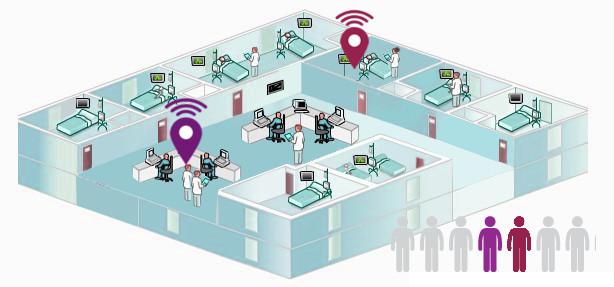
    Real-time location system (RTLS) technology is used in a variety of settings to determine an asset’s relative or exact location at any given moment. In hospitals and other healthcare settings, there are a number of reasons why RTLS technology is valuable:

    • Ensuring high-value equipment stays in the correct location.
    • Locating easily misplaced assets in high-traffic areas (say, an emergency room).
    • Receiving alerts if something leaves a hospital floor.
    • Monitoring people in the hospital, whether they are patients, doctors, or miscellaneous staff.

    RTLS technology has been around in various forms for about 15 years—so it exists in many different forms:

    • Infrared RTLS, like Versus.
    • WiFi RTLS, like Ekahau.
    • Ultra wide-band RTLS, like Zebra.
    • Low-cost RTLS, like AirFinder.

    Each type of RTLS solution has its benefits and drawbacks, and the solution best-suited for your needs depends largely on whether you’re involved with a health care system directly or an OEM who builds RTLS solutions for hospitals. Below, we’ll walk through five things you may want to take into consideration before you select a hospital RTLS.

    5 Things To Consider When Choosing A Hospital RTLS

    1. IS THE SOLUTION WITHIN YOUR BUDGET?

    • Tag costs: A $50 tag may not seem unreasonable—but if you need 5,000 tags, you may run into some budgetary constraints. Additionally, some solutions force you to use a proprietary tag technology instead of allowing you the choice through open source technology. This will definitely up the cost.
    • Power consumption costs: Be sure to consider how much power each tag or access point will draw as well as whether your system (or your customer’s system) can handle it.
    • Labor costs: If someone has to create an elaborate map in order to integrate your RTLS technology, you’re going accrue more labor costs.
    • Integration costs: If you’re integrating an infrared RTLS solution, this will require a great deal of work. You will have to install a tag reader in the ceiling of every room in the network and hardwire those readers back to a central access point. Of course, running cables and power through the ceiling of every room can be very disruptive and difficult to do.

    2. HOW COMPLEX WILL THE IT INTEGRATION BE?

    Working with the IT department to implement a new solution can be a frustrating experience, as it typically involves filling out a lengthy security questionnaire and waiting 3-6 months for approval. Some RTLS solutions—like AirFinder—require no IT integration whatsoever. Be sure to keep this in mind when crafting or purchasing a solution.

    3. HOW MUCH OF THE FACILITY WILL YOU NEED TO OUTFIT?

    If you’re only focused on tracking 10 items in five rooms, integrating an extensive infrared RTLS solution may be wasteful. Carefully consider what you want to track and how much of your hospital or health care system will be affected before choosing your solution.

    4. DO YOU NEED TO KNOW AN EXACT LOCATION OR A PROXIMITY?

    Does it matter whether you can triangulate the exact position of a tracked item, or do you just need to know a general location of the item, at the room level, within your hospital? Keep this in mind when you’re looking at solutions.

    5. WHAT DO YOU WANT TO TRACK?

    If you only need to track expensive capital assets, like an infusion pump or X-ray machine, spending $80 on an RTLS tag isn’t problematic. But if you need to make sure you know where Dr. Bob’s special surgery stool is (so his interns aren’t running around looking for it before the surgery can begin)—or if you want to track 1,000 pillows around the hospital—a $2 tag meets the use case more appropriately.

    The original article can be found here.

    To learn more about RTLSS contact us on sales@rincon.co.in