Tag: Automation

  • Document Management Solution for your customers

    Add value to your offerings by helping customers overcome their paper and e-Document challenges.

    Your customers are battling with an overload of documents. Be it their Finance, Accounts, HR, MRD or any other department, they are flooded with papers, e-mails, and e-Documents. Finding the right document, when needed, is like finding a needle in a haystack.

    The solution? A Document Management System!!

    • It helps locate documents in a jiffy so the team can focus on core activities
    • It offers role-based access for complete privacy & security
    • It improves efficiency by reducing the time spent on managing paperwork and approvals

    Spielberg Solutions GmbH, makers of FileDirector, are a German company focused on providing Document & Content Management software. With over 7000 customers across the world, they have partnered with Rincon India Solutions Pvt. Ltd. for the market in India.

    Rincon is looking at expanding the partner network in India. We have remunerative partner programs to help you better engage your customers and strengthen your bonds.

  • FileDirector For Hospital’s Health Insurance Process Automation


    Many hospitals these days offer cashless hospitalisation. This means that a policyholder who is covered under medical insurance will be able to avail of services at these designated hospitals and their bills would be settled by Insurance Company or their TPA (third party administrators). This saves the policyholder/ immediate family’s blocking of money.

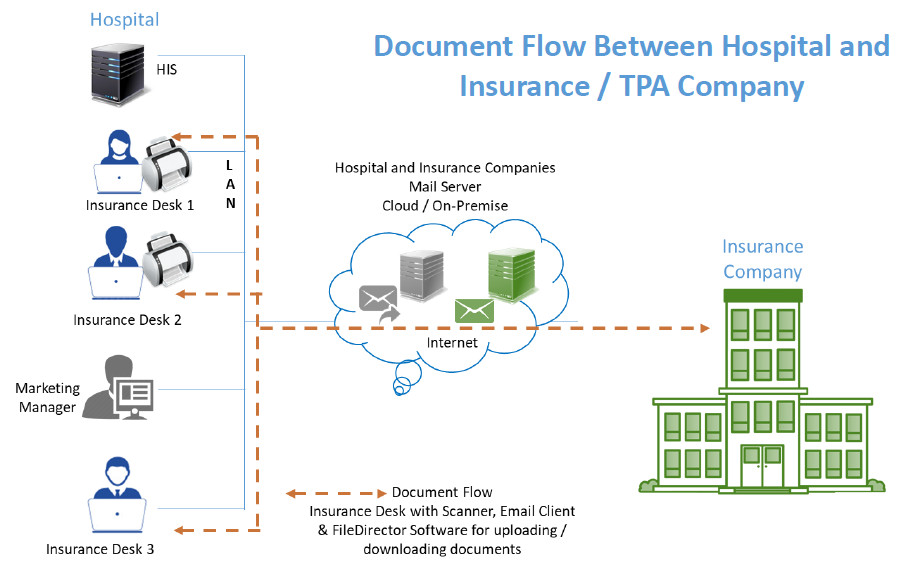
    FileDirector software from Spielberg, Germany would be a good fit to streamline the document exchange process which happens between hospitals and Insurance / TPA companies.

    FileDirector will check for prerequisites and inform whether the machine has sufficient rights for installation, operating system compatibility and if the required ports are open.

    The FileDirector server component will be installed on either

    • Windows 7 or above desktop
    • Windows 2008 or above server

    The FileDirector software will run with SQL Express Database which is free of cost. It will install this component in case it is not there on the FileDirector server.

    The hospital insurance desk will have FileDirector scan station license. It is assumed that the Hospital would have reasonably stable internet connectivity to send / receive documents.

    Hospital will get standard cabinet structure for health insurance records. The structure would include mandatory fields such as Name of the patient, Admission Number, Mobile Number, Policy Number etc. as per Insurance company requirements. Broadly speaking these would be common across all Insurance / TPA companies.

    Hospital would get Masters such as Document type which could include but not limited to pre-authorisation application, Query, Response to query, Approval letter, Letter of denial etc. Masters of Insurance Company as well as TPA would be provided for easy indexing.

    Insurance Desk user would be able to scan / drag and drop the document in FileDirector, Index and send the same to Insurance / TPA company. Option will be available to Scan / drag and drop the document in FileDirector, Index and Hold. He or she will be able to add more documents to make this document set complete and then send to Insurance / TPA company via Email.

    Insurance desk user will have an option to print acknowledgement letter for the patient confirming receipt of the number of documents that have been submitted for Insurance processing.


    Reports:
    The system would be able to generate different reports such as:

    • Claims processed today
    • Pending as of today
    • Approved today
    • Rejected today
    • Rejection with reason
    • Partial approved with reason

    View
    View for checking insurance company’s incoming email messages / documents would be provided using IMAP integration. Insurance desk user will index and store these incoming messages in FileDirector for future retrieval.

    Search
    Users would be able to search documents using one or more indexing parameters and see records.

    For more information e-mail us on sales@rincon.co.in and we will be glad to assist you.


  • Reblog: 2018 Technology Trends

    Find out what XMedius Executive Vice-President and Chief Technology Officer has to say about GDPR compliance, data security, and upcoming tech trends for 2018!

    GDPR is coming into effect in May, what are some of the biggest impacts you think it will have on organizations?

    The General Data Protection Regulation (GDPR) is probably the most transformational digital legislation to ever come into force. Obviously, organizations are racing to meet compliance, but beyond the craze, GDPR will have a long-lasting effect on organizational information architecture in Europe and around the world. Europe is trailblazing with GDPR and it is likely to become the de facto privacy standard for the whole world.

    GDPR solidifies a new fundamental right for European citizens: They have an unalienable right over their personal information. Organizations collecting European citizens are merely the custodian and cannot claim ownership of that information. In the digital world, this is the most significant human right.

    Organizations have traditionally considered information they collect as theirs, so GDPR is significantly changing that state of affairs regarding personal information. In fact, not only are organizations relegated to the role of custodians, but that role now carries significant responsibilities in terms of protecting that information. Much like doctors or engineers in regard to their work, all organizations now have an obligation to protect the personal information they collect.

    As such, organizations have little choice but build the foundation of an information security management system (ISMS), at least with a scope around personal information assets. This will do much to advance information security across the board. If done well, organizations can greatly benefit from the governance framework that will be in place to protect personal information.

    Another big change that GDPR will bring is that prior to GDPR, “digital” personal information had an extremely low “holding cost”. As such, information could be loosely managed, duplicated across several systems, kept for an indefinite period of time, etc. The new requirements around content, access, erasure and protections will create significant costs for collecting and holding personal information and will have a transformative effect on information architecture. With high holding cost, organizations tend to centralize information into a few, well protected & well-governed systems. This type of change will not come in the next 6 months, but is likely to be a long-term effect of GDPR.

    You were a panelist at a BrightTALK conference earlier this year after the prolific WannaCry ransomware attack that affected organizations worldwide. How can companies protect against ransomware in 2018?

    Ransomware protection is a great exemplification of the need for “defense in depth”. There is no silver bullet against ransomware. First, it’s important to understand that ransomware is here to stay, and likely to continue to increase in occurrence and intensity in the years to come.

    The rise of ransomware goes hand-in-hand with cryptocurrency becoming mainstream. Cryptocurrency provides a means to exchange cash equivalents in an untraceable fashion, allowing criminal organizations to expand their extortion business to the digital world with little means for authorities to hinder them.

    1. The economics of ransomware doesn’t make it effective to use zero day vulnerabilities to launch a ransomware attack – instead, they use well-known vulnerabilities. As such, the most effective protection measure against ransomware is aggressive patching practices. Patching is an ungrateful task. It interrupts users work, break systems in unexpected ways, requires testing and causes server downtime, but it is also one of the most effective ways to defend against ransomware by preventing breach and/or limiting its contagion. Take, for example, the two largest breaches of 2017: NHS and Equifax. Both would have been prevented and/or mitigated to a large extent if patching would have been done properly. You don’t need fancy technology, just hard work, commitment and thoroughness.
    2. Backups. If your data is taken hostage, backups will be your best friend. But backups may not be enough in themselves. Ransomware targeting businesses may also target your backup server and/or may encrypt network storage used to store your backup. Offline or offsite backup is the best way to make sure that bad agents cannot prevent you from using your backups to restore data encrypted by ransomware.
    3. Anti-virus & anti-malware is your next line of defense. It helps to prevent the execution of known nefarious code/software. Anti-virus/malware is a requirement, but don’t let this lull you into a false sentiment of protection. Those technologies are not bulletproof, and malware can still get through.
    4. Security Awareness training and phishing impact training are also an important means of stopping ransomware. Users can be your best asset to protect against attacks, but they can also be your worst enemy.
    5. Advanced firewall/NIDS (network intrusion detection systems) may detect or block rogue agents communicating with their command and control, largely mitigating their impact.

    Confidentiality, integrity and availability (or the CIA triad) is a popular model for guiding information security policies within organizations. Are there any extra measures companies can take in 2018?

    Today’s information security model is commonly based on the CIA triad, but never before has information taken so many physical forms. With the advent of the Internet of things (IoT), we may need to also evaluate the security objectives of information assets in regard of the physical integrity of human beings. This is particularly true for autonomous robots or vehicles.

    What is the appropriate level of security regarding human life? A good example of the blurred line of information vs physical security is the recent demonstration by researchers that autonomous driving systems could be “hacked” by putting simple stickers on a stop sign, rendering it unrecognizable and possibly leading to traffic accidents causing serious or fatal injuries.

    What is the acceptable level of physical protection required for implementing surgical robots? Armed robotic guards? Autonomous flying airplanes? Manufacturing robots? Drones?

    As AI and IoT create new forms of autonomous objects, there is a need to integrate security approaches on both information and physical security. An integrated approach is more likely to address all the risks and provide security controls that work towards common goals.

    As someone with their finger on the pulse of technology, what are some of the most innovative ideas you see emerging on the market in 2018?

    Zero UI: The combination of voice recognition technology, natural language API and deep learning is likely to finally deliver on the promises of Zero UI where requests and responses can be achieved in a natural discussion, eliminating the need for a formal user interface. ZeroUI has some limited success in virtual assistants, but is now likely to refine and expand to more diverse systems.

    Specialized AI: Despite the hype, computers showing humanlike “generalized” intelligence is not around the corner – it’s still decades away. Nevertheless, computer systems managing to show human intelligence for performing very specific tasks are already available. These systems will revolutionize the workplace and are likely to transform it much like computers and the Internet did decades ago. AI will not “replace” humans per se, but change the way our work is done and make us more productive, allowing us to concentrate higher value tasks. On the downside, this is likely to further increase the digital divide, between workforces that can harness digital/AI and those who cannot.

    Compliance: The cost of cyber crime that is already estimated to exceed $3 trillion which is likely to double by 2021 and is a phenomenon considered by experts to be “out of control”.

    Authorities across the world are putting together new regulations to impose some basic standards in terms of how organizations need to protect information assets. After HIPPA, FERPA, PCI-DSS, GDPR more compliance regulations, whether compulsory or mandated, are likely take force in 2018 and the years to come. All organizations will need to stay on the lookout and adjust their IT strategy in accordance. For those that are not prepared, the change will be painful.

    Automation: With salaries rising in East Asia, there is a trend to bring manufacturing closer to its intended market. Robots and automation have reached a tipping point in terms of tasks they can perform and can now replace low-wage workforces in several areas. This will not only transform manufacturing, but also local services like restoration and retails where several tasks can now be economically automated.

    Want to learn more about how you can enable compliance, prevent data breaches, and take your organization’s data governance to the next level? Speak with an expert today about solutions that cater to your specific business needs. Contact us.

    The original article can be found here.

  • Document Management Software for Financial Services

    Banks and Financial institutions including Mutual Funds, Insurance companies have to deal with a plethora of documents. These documents are vital as they are mandated by regulations and compliance with regulations is a must.

    As an example, banks have to comply with KYC (Know Your Customer) norms. KYC is a process by which banks obtain information about the identity and address of the customers. This process helps ensure that banks’ services are not misused. The KYC procedure is to be completed by the banks while opening accounts. Banks are also required to periodically update their customers’ KYC details. A bank needs to collect proof of identity and proof of address apart from the photograph of every customer. The Reserve Bank of India has specified 6 documents which can be produced for either or both of the above needs. Banks are required to periodically update KYC records. This is a part of their ongoing due diligence on bank accounts. The periodicity of such updation varies from account to account depending on its risk categorisation by the bank. Periodic updation of records also helps prevent frauds in customer accounts. Let us take State Bank of India with 31 crore savings accounts or in other words 310 million accounts. If each account has to produce 1 page as a KYC proof, there are 310 million pages to manage.

    And it is not just the KYC documents that have to be managed. There are other documents pertaining to Trade, Foreign Exchange and other departments.

    Managing such a large volume of documents manually is a tall order and retrieving a particular document is akin to finding a needle in a hay stack.

    It goes without saying that privacy and safety of this information is crucial.

    This is the reason why Banks and Financial institutions opt for automation solutions based on Spielberg and other software provided by Rincon.

    Rincon helps customers in automating documents every step of the way. Right from scanning paper documents, converting them into electronic images, building document workflows, to quick retrieval all of these from a central repository. Not only does Rincon help in automation but also helps in restricting access to documents. Thus users from Department A need not view documents from another department or whatever other rules that may be needed by the business process.

    Being a centralised repository of electronic documents, the distance between people no longer matters. Whether the person is sitting in the remotest corner of Arunachal Pradesh in the East or maybe in the Andaman and Nicobar islands, as long as he / she has access to the internet, he can access the system using a web browser. The user can view the documents he /she is authorised to and can even upload documents if he is allowed to upload. Thus the entire system is now centralised and everyone can finish off their work without having to depend on the efficiency of the courier system or postal services.

    Apart from all the above benefits, some of the other benefits:

    Save on expensive real estate: When you have to store physical papers, it calls for a lot of real estate which in today’s times is definitely not cheap. With an automation solution in place, you could move the physical documents to an offsite (less expensive) place and store it there.

    Retention policy: You can define the life cycle of the documents so say if the KYC documents are to be collected every 2 years, you could set the life cycle of the documents for 3 years so that the older records would be purged after 3 years. Thus your data size also remains manageable.

    Integration with LoB (Line of Business) Applications: The automation solution can also be integrated with the LoB applications thus streamlining a lot of processes.

    Rincon helps organisations of all sizes to handle their documents right from delivery to destruction. Contact us on sales@rincon.co.in for a free consultation on how we could assist you in your existing processes.

  • Repost: GST may add to India Inc’s documentation burden

    India gears up for GST to be rolled out from July 1. However, have we thought of the documentation needed for compliance? Here is an interesting article.

    Industry is worried it might face increased compliance burden due to rules under the proposed goods and services tax (GST) regime.

    Companies would have to upload three returns every month – by the 10th, 15th and 20th of the month after a sale happens, said M S Mani, senior director, indirect tax, Deloitte.

    According to rules on returns, companies would have to submit details of its supplies or invoices by the 10th of the subsequent month. They have to upload details of purchases of inputs by the 15th of the subsequent month.

    GST returns, carrying details of taxes paid and input credit taken, have to be filed by the 20th of the next month, said Mani. Besides, by the next year-end, companies would have to upload annual returns as well.

    This would burden industry with too much compliance. Service companies such as Infosys, Tata Consultancy Services (TCS) and Airtel, among others, would be particularly hit.

    Service providers would have to file 37 returns each a year, said Mani, from two returns – one every six months – now.

    Besides, service tax is a central duty. So service providers do not have to file returns in each of the state where they have offices. This will, however, change under the GST regime and they would have to file 37 returns for each state they have an office in, besides the central government.

    Currently, goods companies, on their part, have to file returns every month for value-added tax (VAT) and excise duties.

    The GST Council is to discuss pending rules and changes to the already approved norms this month-end. The Council will work out rules on composition, valuation, input tax credit and transitions on March 31.

    It has already approved rules on refunds, invoices, returns, payments and registration. The government had made public rules on five categories before taking these to the Council. But it would not do so in case of pending rules, said officials.

    Industry is worried that online marketplace players such as Flipkart and Amazon will have to pay up to one per cent tax collected at source (TCS) – rules for which have not yet come — on behalf of vendors and this would add too much procedural work.

    S S Gupta of Taxmann said these marketplaces have thousands of vendors and to exactly match TCS of each would be extremely difficult. If anything goes wrong while matching, the input credit would go to another and the vendor would be asked to pay more, he said.

    If a customer returns a product purchased via an online marketplace, it will take time to reach the supplier. By then, TCS might have been paid by the online company. If that vendor does not supply to the online company again, the marketplace would have to bear the burden, explained Gupta.

    Though a cap on TCS has been reduced from two per cent in draft GST Bills to one per cent in the revised drafts approved by the Council, the tax is not aimed at revenue generation but to keep a track of vendors by the tax authorities.

    The government’s logic has been that as it can’t go after every vendor, it would ask the marketplace to deduct TCS. Keeping track of the vendors and not revenues was the concern here, said the expert with Taxmann.

    Mani said the government was basically burdening industry with compliance, even in areas where the authorities should take the responsibility.

    The other issue relates to input tax credit, rules on which are yet to come. However, rules would not contradict the Bills. A buyer would not get input tax credit unless the supplier concerned paid tax. In state-level VAT, input tax credit would be given as soon as the invoice was uploaded, he added.

    Archit Gupta, founder & chief executive officer of ClearTax.com, said there might be issues around pre-existing VAT credit in the earlier regime when these goods are exempted in GST. “So we hope this is covered under the inputs credit and transition rules.”

    For a truly unified structure, he said, the government must focus on greater fungibility of credit.

    “Exempted excise manufacturers and exempted VAT manufactures may have to face GST rates and taxes, and most of these are state-specific exemptions. So it needs to be seen how these concerns can be uniformly addressed,” added Gupta.

    The Council has cleared all GST Bills and most of these will go to the Cabinet and be tabled in Parliament. Similarly, state GST Bills will be moved to the respective state Cabinets and Assemblies. Only rules and item-wise rates have to be decided.

    While we would have electronic filing, we still have to maintain the pdf files for records. Do give a thought to managing so many files which may be pdfs or maybe hard copy. A Document Management System can help overcome these challenges. Contact sales@rincon.co.in on how we can help achieve your goals and overcome your obstacles.

    The original article appears on rediff.com and is available here

  • Document Management system for Property Management organisations

    paperpiles

    A Property Management organisation is one that looks after the management of personal property, equipment, tooling and physical capital assets that are acquired and used to build, repair and maintain end item deliverables. Property management involves the processes, systems and manpower required to manage the life cycle of all acquired property as defined above including acquisition, control, accountability, responsibility, maintenance, utilization and disposition.

    These organisations have to manage leases, contracts, notices, and other property records in a property document management system that keeps important property documents secure and makes them easily retrievable.

    With a document management system in place, property managers, property owners, and property management staff can use it to improve efficiency and make informed decisions regarding the leasing and ownership of property.

    A document management system keeps all records, including important plans and facilities documents, ready for access. Authorised persons can access files outside the office using Web and Mobile access. Users are able to search and retrieve documents on the fly thereby enabling them to make faster and more accurate decisions.

    If you are considering the implementation of a document management system for your business, but you are still on the fence when it comes to selecting the right solution, please e-mail us on sales@rincon.co.in and we will be glad to assist you.

  • Document Management System for Accounts Payable

    Accounts Payable (AP) is a basic function of every organisation. Whatever be your business, you will have invoices to pay, processes to adhere to and accountability to document. Missed early payment discounts, late fees, lost invoices, dozens of calls, emails, faxes, and other inefficiencies can substantially drive up your operating costs.

    Beyond invoices and payments, there are compliance issues surrounding accounting. Auditors require an ability to keep track of and report all aspects of your accounting system and processes including Accounts Payable. Failed audits resulting from lost documents or poor documentation can result in large fines, or a range of other penalties.

    With a Document Management System (DMS) in place, you can ensure processes are being adhered to and are fully auditable. It allows you to:

    • Secure and keep track of all incoming invoices and related documents (PO’s, notes, GRNs, etc.)
    • Ensure early payment discounts and eliminate late payment fees
    • Reduce data entry errors
    • Compare approved purchase order amounts to invoices and eliminate overpayment
    • Ensure all your accounting procedures and approvals are adhered to using automated routing for review, approvals, and processing

    If you are considering the implementation of a document management system for your business, but you are still on the fence when it comes to selecting the right solution, please e-mail us on sales@rincon.co.in and we will be glad to assist you.

  • Fax automation in Mutual Funds

    Mutual FundsThe Mutual Fund industry in India has been growing rapidly with the assets under management (AUM) on the rise.
    Mutual Funds are governed tightly by the authorities and have to meet strict guidelines.

    One of the guidelines specified is cut off time so that purchase or redemption requests have to be made before a certain time which can be communicated via fax as well.

    Earlier in those days of fax machines, there was no time trail.

    With our expertise in Fax, we have developed modules to help Mutual Funds comply with the time guidelines.

    Just send a mail to us on sales@rincon.co.in and we will be more than happy to help you.

  • Automation of Insurance Process at Hospitals

    Simplification of insurance processes

    Many big hospitals these days offer cashless hospitalisation. This means that a policyholder who is covered under medical insurance will be able to avail of services at these designated hospitals and their bills would be settled by Insurance Company or their TPA (third party administrators). This saves the policyholder / immediate family’s blocking of money.

    (more…)