Tag: Documents

  • Document Management for HR

    Human Resource Management can be a source of strategic advantage for every company, but is your Human Resources department able to effectively and efficiently do their job?

    The amount of paper and electronic documents that any HR department generates and receives can be huge with numerous files having to be maintained for every employee and applicant. In addition, ensuring compliance with regulations is essential as well as improving departmental efficiency.

    Key Document Management Issues Facing HR Managers

    Issues
    • Growing volumes (and duplication) of paper and electronic records
    • Manual processes to copy, email, mail, and file HR documents
    • Inconsistent document processes across locations
    • Lack of reporting or audit capability for more complicated internal and external requests
    Impact
    • Slow, sometimes incomplete ability to access employee files
    • Higher labor costs
    • Missing HR files
    • Duplication of effort
    • Can’t verify document retention
    • Delays in processing paper work
    • Risk of fines for noncompliance
    • High storage and shipping costs
    • Privacy and security concerns
    What HR Managers Must Do
    • Create fast and easy access to documents
    • Ensure document security, backup and recovery
    • Reduce storage and shipping costs
    • Improve reporting and audit capabilities
    • Increase productivity
    • Reduce exposure to compliance fines
    • Optimize use of HR staff
    How FileDirector can assist?

    Our document management software for Human Resources helps HR department retain documents for the appropriate time and improve office efficiency. Personal information for every employee and applicant’s information is safely stored in our electronic repository for quick and easy access.

    Now every resume, cover letter, internal memo, employee review, sick leave request and more is traceable and easily maintained.

    Benefits:
    • Central repository for all HR documentation
    • Save time and space filling and retrieving documents
    • Create segregated and secured personnel documents
    • Develop best practices for your departmental records management
    • Rapid Deployment equals rapid ROI
    • Guaranteed user adoption with the user friendly, flexible interface
    • Let HR staff focus on core activities and less on paperwork
    • Know the status and location of all candidates and employee records in your system
    • Enable staff to view required documents simultaneously
    • Never lose or misplace a file again!

    E-mail us on sales@rincon.co.in for more information and we will be glad to assist you.

  • Reblog: Arizton Report Reveals Valuable Global Fax Market Insights

    Arizton Advisory & Intelligence is a market research organization that produces premium market research solutions and customized reports for a wide variety of industries. They track both high growth and niche markets across industries, such as:

    • Consumer Goods & Retail Technology
    • Automotive & Mobility
    • Smart Tech
    • Healthcare and Lifesciences
    • Industrial Machinery
    • Chemicals & Materials
    • IT & Media
    • Logistics & Packaging

    Arizton recently released their “Global Fax Services Market Outlook and Forecast 2017-2022”, and once we heard about it we naturally jumped at the opportunity to get our hands on it! The report is chock-full of industry tidbits and also contains their 5-year forecast of the global fax services market. Here are 4 of what we consider to be the key takeaways from their 2017 report.

    1. Fax Services Reduce Carbon Footprint

    It’s important to indicate that for the context of this article, the term “fax services” refers to the plethora of on-premise, cloud-based, hybrid, and secure file exchange solutions on the market that have been developed to replace traditional, paper-based faxing. Most people are aware that by switching to a digital fax solution they reduce paper usage within their organization, but Arizton’s findings delve a little deeper. In discussing market growth enablers in their Global Fax Services Market report, Arziton mentions that modern fax services reduce the usage of paper by up to 75% across organizations of all sizes.

    Computer-based fax solutions reduce paper use not only by replacing traditional fax machines, but by replacing other workflows involving paper, such as scan-to-email workflows as well. The report estimates that in a single year, 150 billion papers are used for faxing purposes in the US alone.

    As awareness and initiatives to create a “green office environment” grow across all industries, on-premise and cloud-based faxing services have helped organization’s paper requirements decrease significantly over the last decade. Every organization that adopts cutting-edge fax solutions not only minimizes their own carbon footprint, they help reduce the need for paper production in general.

    2. Fax Automation Workflow is a growing trend

    Arizton’s report explains that fax automation has grown to become one of the most popular features of today’s fax solutions for organizations who largely operate in a transaction-based environment. The automated sending of documents is especially appealing to companies whose document processing needs are growing, and is an available feature provided by various fax services vendors in the industry.

    Fax automation is achieved by integrating on-premise or cloud-based solutions with existing customer applications, such as CRM. Users can then predefine numerous documents and contacts for automatic transmissions based on their business needs.

    3. There’s still a lack of awareness of traditional fax alternatives

    Although there are several models of fax solutions on the market to replace the traditional fax infrastructure, the Arizton report explains that lack of awareness of fax services often leads to usage of email as a substitute. Many organizations replace traditional fax by sending documents via email after scanning them through hardware devices.

    Email may provide a faster and more convenient alternative to using fax machines, but it isn’t inherently secure and without the right security measures in place, an organization’s data governance may not meet compliance regulations. Fax solutions that integrate directly with user email applications are a modern, secure, and compliant alternative that allow users to continue to send and receive files from the platforms they’re most comfortable working with. Several contain a built-in audit trail function to eliminate any guesswork should an organization come under regulatory audit.

    4. The Healthcare industry is leading the fax services adoption pack

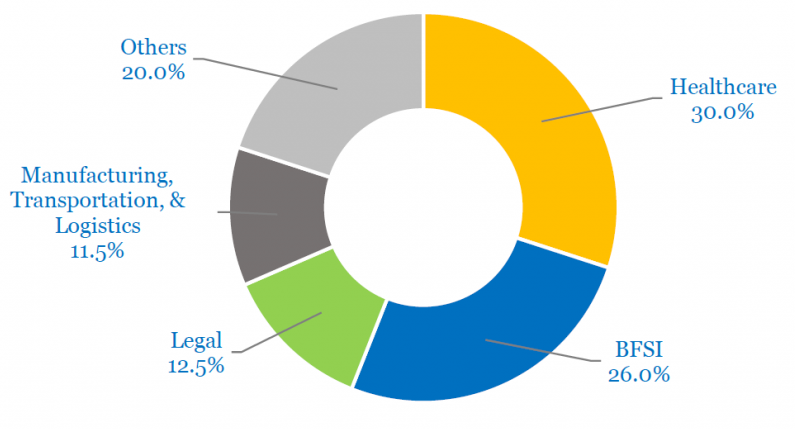
    Several end-user industries are discovering that modern fax solutions are a great way to increase productivity, save cost, and enable a more compliant environment, but none more than the healthcare sector. Ariston reports that healthcare (which includes hospitals, clinics and pharmaceutical companies) is the biggest revenue contributor for fax services, representing 30% of the global market. Healthcare organizations mainly opt for fax services to ensure the secure transmission of patient documents which helps comply with regulatory compliance like HIPAA in the US, not to mention that fax solutions can also automate several document management processes. In coming years, Arizton expects healthcare revenues to continue to grow as fax solutions become more widely used by individual physicians and the use of fax solutions grows in the APAC regions.

    A close runner-up, representing 26% of global revenue for the fax services market is the Banking, Financial services and Insurance (BFSI) sector, with banks and insurance organizations are the leading revenue contributors, followed by mortgage companies. The Arizton report forecasts that by 2022, more organizations in the financial sector are expected to migrate towards hybrid fax solutions. Hybrid fax solutions give companies greater control over their data with on-premise server deployments, yet also offer the flexibility and scalability of cloud fax solutions.

    Looking for a fax solution that can boost productivity, automate workflows, and help your organization meet regulatory compliance no matter what industry you’re in? Contact us.

    The original article can be found here.

  • Document Management Software for Financial Services

    Banks and Financial institutions including Mutual Funds, Insurance companies have to deal with a plethora of documents. These documents are vital as they are mandated by regulations and compliance with regulations is a must.

    As an example, banks have to comply with KYC (Know Your Customer) norms. KYC is a process by which banks obtain information about the identity and address of the customers. This process helps ensure that banks’ services are not misused. The KYC procedure is to be completed by the banks while opening accounts. Banks are also required to periodically update their customers’ KYC details. A bank needs to collect proof of identity and proof of address apart from the photograph of every customer. The Reserve Bank of India has specified 6 documents which can be produced for either or both of the above needs. Banks are required to periodically update KYC records. This is a part of their ongoing due diligence on bank accounts. The periodicity of such updation varies from account to account depending on its risk categorisation by the bank. Periodic updation of records also helps prevent frauds in customer accounts. Let us take State Bank of India with 31 crore savings accounts or in other words 310 million accounts. If each account has to produce 1 page as a KYC proof, there are 310 million pages to manage.

    And it is not just the KYC documents that have to be managed. There are other documents pertaining to Trade, Foreign Exchange and other departments.

    Managing such a large volume of documents manually is a tall order and retrieving a particular document is akin to finding a needle in a hay stack.

    It goes without saying that privacy and safety of this information is crucial.

    This is the reason why Banks and Financial institutions opt for automation solutions based on Spielberg and other software provided by Rincon.

    Rincon helps customers in automating documents every step of the way. Right from scanning paper documents, converting them into electronic images, building document workflows, to quick retrieval all of these from a central repository. Not only does Rincon help in automation but also helps in restricting access to documents. Thus users from Department A need not view documents from another department or whatever other rules that may be needed by the business process.

    Being a centralised repository of electronic documents, the distance between people no longer matters. Whether the person is sitting in the remotest corner of Arunachal Pradesh in the East or maybe in the Andaman and Nicobar islands, as long as he / she has access to the internet, he can access the system using a web browser. The user can view the documents he /she is authorised to and can even upload documents if he is allowed to upload. Thus the entire system is now centralised and everyone can finish off their work without having to depend on the efficiency of the courier system or postal services.

    Apart from all the above benefits, some of the other benefits:

    Save on expensive real estate: When you have to store physical papers, it calls for a lot of real estate which in today’s times is definitely not cheap. With an automation solution in place, you could move the physical documents to an offsite (less expensive) place and store it there.

    Retention policy: You can define the life cycle of the documents so say if the KYC documents are to be collected every 2 years, you could set the life cycle of the documents for 3 years so that the older records would be purged after 3 years. Thus your data size also remains manageable.

    Integration with LoB (Line of Business) Applications: The automation solution can also be integrated with the LoB applications thus streamlining a lot of processes.

    Rincon helps organisations of all sizes to handle their documents right from delivery to destruction. Contact us on sales@rincon.co.in for a free consultation on how we could assist you in your existing processes.

  • Reblog: How financial institutions can easily comply with the SOX Act

    The following article is the first one of a series of three about how the fax can help financial organizations to meet their legal obligations. This first text covers Sarbanes-Oxley, a legislation passed by the U.S. Congress to protect shareholders like you and me.

    Despite what people might think, the fax is still an essential communication tool in the financial sector. From banks and insurance companies to investment management and advisory firms, financial service organizations share high volumes of sensitive data. Document transactions are part of complex workflows and information is manipulated by numerous people in different geographic locations, demanding anytime/anywhere access.

    Finance-driven documents

    • Credit applications
    • Financial reports and statements
    • Fund transfers
    • Invoices
    • Loan approvals and denials
    • Mortgage documents
    • Trade confirmations
    • Regulatory disclosures and information
    • Securities reports

    Decision makers are continuously seeking better ways to keep their IT infrastructure costs and operational risks under control while addressing security concerns and complying with stringent industry regulations. Many firms recognize the advantages of moving to the cloud in order to reduce costs, but are rightly concerned about the security of their confidential information.

    The transmission of information by fax remains a critical component of an information system. Choosing a fax provider with a proven track record and demonstrated expertise in developing enterprise-class cloud fax services is of paramount importance.

    SARBANES-OXLEY

    Sarbanes-Oxley (SOX) was implemented in 2002 and legislates how business records are protected and preserved to prevent destruction and corruption. SOX has also set e-records management standards to which all businesses should adhere. SOX mandates that all electronic records (including faxes), be retained for a period of seven years. Furthermore, it requires tamper-proof resources to prevent the corruption and modification of records. This rule is designed to protect investors from fraudulent activity and to safeguard financial data.

    Entities subject to SOX compliance include all US-based publicly traded companies and international companies that have registered equity or debt securities with the Securities and Exchange Commission. Accounting firms that provide auditing services to the above entities are also subject to SOX compliance.

    How XMediusFAX® helps achieve SOX compliance standards

    • Offers secure and real-time fax transmission
    • Faxes are sent and received directly from any application to the intended recipient’s fax number, with notification of receipt and routing of incoming faxes to intended recipients’ email inboxes, network folders or secure printers.
    • Provides a centralized solution – XMediusFAX® allows for secure integration with corporate systems such as ERP, Document Management, Archiving, and virtually any other 3rd party network application to enable inbound and outbound document delivery via fax, email or the Internet.
    • Maintains electronic storage and an audit trail of fax transmission logs
    • XMediusFAX® can be configured to store all incoming and outgoing faxes electronically in a secure cloud-based storage environment, or on a network archiving system or database. It also allows users and administrators to track fax history and verify fax delivery.

    Along with the ability to set up notifications for deliveries and receipts, a complete audit trail of fax activity is also provided.

    XMediusFAX® is ISO 27001 certified for its Information Security Management System (ISMS). The infrastructure supporting the XMediusFAX® service meets the rigorous physical, technical, administrative, processes and management controls required to achieve the highest security standard. ISO 27001:2013 can therefore be used to help verify SOX compliance.

    In short, XMediusFAX® offers a level of security and protection that very few fax cloud providers can match. Clients operate across regulated industries and require an enterprise-grade faxing solution to achieve the highest security standards. XMediusFAX® is that solution.

    Discover how XMedius helped KPMG Australia to reach a higher level of security while reducing their costs associated with faxing: https://www.xmedius.com/en/industries/finance/

    The original article can be found here.

    To learn more contact us sales@rincon.co.in

  • Repost: GST may add to India Inc’s documentation burden

    India gears up for GST to be rolled out from July 1. However, have we thought of the documentation needed for compliance? Here is an interesting article.

    Industry is worried it might face increased compliance burden due to rules under the proposed goods and services tax (GST) regime.

    Companies would have to upload three returns every month – by the 10th, 15th and 20th of the month after a sale happens, said M S Mani, senior director, indirect tax, Deloitte.

    According to rules on returns, companies would have to submit details of its supplies or invoices by the 10th of the subsequent month. They have to upload details of purchases of inputs by the 15th of the subsequent month.

    GST returns, carrying details of taxes paid and input credit taken, have to be filed by the 20th of the next month, said Mani. Besides, by the next year-end, companies would have to upload annual returns as well.

    This would burden industry with too much compliance. Service companies such as Infosys, Tata Consultancy Services (TCS) and Airtel, among others, would be particularly hit.

    Service providers would have to file 37 returns each a year, said Mani, from two returns – one every six months – now.

    Besides, service tax is a central duty. So service providers do not have to file returns in each of the state where they have offices. This will, however, change under the GST regime and they would have to file 37 returns for each state they have an office in, besides the central government.

    Currently, goods companies, on their part, have to file returns every month for value-added tax (VAT) and excise duties.

    The GST Council is to discuss pending rules and changes to the already approved norms this month-end. The Council will work out rules on composition, valuation, input tax credit and transitions on March 31.

    It has already approved rules on refunds, invoices, returns, payments and registration. The government had made public rules on five categories before taking these to the Council. But it would not do so in case of pending rules, said officials.

    Industry is worried that online marketplace players such as Flipkart and Amazon will have to pay up to one per cent tax collected at source (TCS) – rules for which have not yet come — on behalf of vendors and this would add too much procedural work.

    S S Gupta of Taxmann said these marketplaces have thousands of vendors and to exactly match TCS of each would be extremely difficult. If anything goes wrong while matching, the input credit would go to another and the vendor would be asked to pay more, he said.

    If a customer returns a product purchased via an online marketplace, it will take time to reach the supplier. By then, TCS might have been paid by the online company. If that vendor does not supply to the online company again, the marketplace would have to bear the burden, explained Gupta.

    Though a cap on TCS has been reduced from two per cent in draft GST Bills to one per cent in the revised drafts approved by the Council, the tax is not aimed at revenue generation but to keep a track of vendors by the tax authorities.

    The government’s logic has been that as it can’t go after every vendor, it would ask the marketplace to deduct TCS. Keeping track of the vendors and not revenues was the concern here, said the expert with Taxmann.

    Mani said the government was basically burdening industry with compliance, even in areas where the authorities should take the responsibility.

    The other issue relates to input tax credit, rules on which are yet to come. However, rules would not contradict the Bills. A buyer would not get input tax credit unless the supplier concerned paid tax. In state-level VAT, input tax credit would be given as soon as the invoice was uploaded, he added.

    Archit Gupta, founder & chief executive officer of ClearTax.com, said there might be issues around pre-existing VAT credit in the earlier regime when these goods are exempted in GST. “So we hope this is covered under the inputs credit and transition rules.”

    For a truly unified structure, he said, the government must focus on greater fungibility of credit.

    “Exempted excise manufacturers and exempted VAT manufactures may have to face GST rates and taxes, and most of these are state-specific exemptions. So it needs to be seen how these concerns can be uniformly addressed,” added Gupta.

    The Council has cleared all GST Bills and most of these will go to the Cabinet and be tabled in Parliament. Similarly, state GST Bills will be moved to the respective state Cabinets and Assemblies. Only rules and item-wise rates have to be decided.

    While we would have electronic filing, we still have to maintain the pdf files for records. Do give a thought to managing so many files which may be pdfs or maybe hard copy. A Document Management System can help overcome these challenges. Contact sales@rincon.co.in on how we can help achieve your goals and overcome your obstacles.

    The original article appears on rediff.com and is available here

  • Reblog: Fax Server, Less a Luxury, More a Necessity for Any Business

    Technology is revolutionary and each industry is taking benefit of it. Businesses are moving towards the digital revolution. A few tradition are still as important as it was before. Faxing is one of those traditions still having its own importance in businesses and many industries. Still, a few documents such as contracts, legal papers, bills, etc. needs to get faxed as fax has its own legal value. The technology has also paved its way into the faxing to satisfy the business need. The fax server is a technological advancement to make the faxing digitized.

    Fax servers can use the traditional lines or VoIP to send and receive faxes. One of the most widely accepted efaxing technology is FoIP (Fax over IP). It uses the cost-effective and reliable VoIP technology to send the faxes.

    The fax server converts the documents into the digitized format and send it using the predefined channels. It gets converted into the original format at the receiving end. It can be either printed document or an email based on the configuration.

    Benefits of The Fax Server For Any Business:

    • Reduced Costs
      The fax server reduces the operational cost and stationary required in traditional faxing. It eliminates the papers, toner, and bulky fax machines. It also reduces the maintenance cost required to maintain the traditional machines. The fax servers don’t require any extra hardware or plug-ins to work efficiently, which makes it perfect for any business.
    • Improved Productivity
      The faxing can be performed from anywhere with the FoIP. It eliminates the possible long queues to send the fax from the physical machine. With the fax server, one may easily send the faxes using their desktops, laptops, tablets and even phones.
    • Leveraged Network
      The fax servers eliminate the extra telephone lines required for the fax server. It takes the complete benefit of the existing VoIP network. It also removes the need of extra wiring which makes it more scalable and extensible.
    • 24*7 Availability On Finger Tip
      The fax server can be integrated into the web, software or any mail server based on company’s requirement and choice. It makes it available 24*7 even when you are traveling or on a dinner table. You may send and receive the faxes from anywhere using your simple web or mail servers.
    • Robust Disaster Management
      Majority of the fax servers come with the security configuration. It makes the copy of each or important documents on the server which works as a disaster management. Any time, one can get the backup and recover the lost faxes which is nearly impossible with the traditional fax system.
    • Competitive Edge
      The fax servers give a competitive edge to the business with its advanced features. For example, companies can add their own cover page as a signature of all their documents sent to other firms. It also gives notification once the fax is received by the receiving party. The fax can be auto forwarded in case of failure. It gives a competitive edge to any business.

    There is a plethora of advantages rendered by the fax server software. The modern fax server software has many features which makes it more appropriate compared to the traditional fax machines. It provides the fax templates which can be used to send the faxes of the same nature. One may also block unwanted faxes with ease. The color faxing can never be so easy and cheap as it is with the FoIP software. Any business can use their resources efficiently and improve the productivity by giving their business a professional touch with the fax server software.

    If you are considering implementing a fax management solution for your organisation, but are still sitting on the fence when it comes to selecting the right solution, we encourage you to e-mail us on sales@rincon.co.in and we will be glad to assist you.

  • Reblog: The Top 7 Benefits of Document Management Systems

    Documents, whether electronic or paper, are an essential component of just about any enterprise. Managing business information, sometimes from several sources, can be a challenging task. Depending on the nature of your company, a document management (DM) solution that captures, stores, and retrieves both paper and electronic documents can provide many key benefits to your organization.

    In this post, I’ll discuss the top 7 benefits of document management systems, including:

    Reduced Storage Space
    Enhanced Security
    Improved Regulatory Compliance
    Easier Retrieval
    Better Collaboration
    Better Backup and Disaster Recovery
    And the “Intangibles”
    Read on to learn more!

    1. Reduced Storage Space

    Commercial property costs are increasing and so is the expense to store paper documents. A software-based document management solution (DMS) that can reduce the need for file cabinets, boxes and storage bins is a valuable asset to any enterprise, freeing up precious office space. Documents that have to be kept as hard copies can often be stored in less expensive locations, such as an offsite warehouse or vault.

    2. Enhanced Security

    Document security is vital to many enterprises. DMS provides better control over sensitive documents. Access to documents can be controlled at the folder level for different groups or individuals. Also, a DMS leaves an audit trail of who has viewed a document, when it was accessed, and how it may have been modified. Managed documents are highly traceable and can be tagged to allow for automated alerts.

    3. Improved Regulatory Compliance

    Compliance requirements for certain documents can be quite complex. Non-conformance can lead to fines, revoked licenses, and in some cases criminal liability. Federal and state regulatory regulations such as Sarbanes Oxley and HIPAA mandate strict security and privacy guidelines. DMS reduces the risk of non-compliance. Records retention schedules, for example, can be automated, and new documents can be more easily classified and stored.

    4. Easier Retrieval

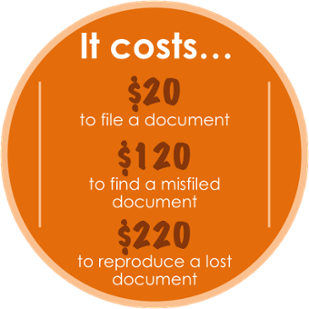
    Searching for and retrieving documents can be very time consuming – and we all know time is money. In fact, PWC published these statistics illustrating the costs related to the average time spent managing paper documents:

    1. Organizations spend $20 in labor to file a document, $120 in labor to find a misfiled document, and $220 in labor to reproduce a lost document.
    2. 7.5% of all documents get lost; 3% of the remainder get misfiled.
    3. Professionals spend 5 to 15% of their time reading information, and up to 50% of their time looking for it.

    A document management solution, specific for your enterprise, can be a powerful, time-saving tool. Depending on the solution implemented, a DMS can retrieve files by a word or phrase in a document – full text search, or DMS can apply index categories to a document or folder. Easier integration with business applications facilitates access to critical information. DMS also gives the opportunity to access documents remotely. As long as there is internet connection, documents can be accessed from virtually anywhere.

    5. Better Collaboration

    With DMS, information sharing and collaboration can be a lot easier. Documents captured from different sources can be accessed from multiple locations. Electronic imaging makes sharing documents over a network via email or the Internet possible. DMS provides greater visibility to business processes and can allow for better workflow monitoring. Authorized access by external users can be allowed and monitored. DMS also offers Version Control which allows for older versions of the same document to be recovered if needed. This feature is important if several parties work on the same document and there are changes made to a document that were not authorized or meant to happen.

    6. Better Backup and Disaster Recovery

    Any document management solution should include a data backup and disaster recovery plan. With digital archiving as a backup, paper documents are protected from fire and flood and other disasters. With a DMS, documents are highly traceable and can be tracked within a range of criteria.

    Also, because imaged documents are centrally stored they cannot be lost or misplaced after viewing. Documents are less likely to be misfiled, and if so they are easier to locate with cross-indexing. Documents can be digitized and archived at their point of entry into the system.

    7. The Intangibles

    Just a few of the intangible benefits of a document management system include:

    1.Flexibility
    2.Competitiveness
    3.Improved client relations
    4.Peace of mind

    Time is valuable, and time saved is a definite benefit of DMS that often translates directly into increased productivity. Faster and more efficient document retrieval can boost staff morale and increase client satisfaction. Also, document management solutions are scalable to meet the changing needs of any enterprise.

    Proper document management systems can bring many benefits to you and your office. Take initiative and schedule a demo today to see how a tailored document management solution can help you by improving business processes and increasing efficiency.

    The original article can be found here.

    If you are considering implementing a document management system for your business, but you are still sitting on the fence when it comes to selecting the right solution, we encourage you to e-mail us on sales@rincon.co.in and we will be glad to assist you.

  • Proof of Delivery Management

    Proof of delivery (POD) is a method to establish the fact that the recipient received the contents sent by the sender. When the sender sends multiple documents through mail or through a courier service, there is a possibility of some not reaching the intended recipient.

    Proof of delivery becomes very important when legal and financial documents are to be exchanged between two parties. Commercial fleet operators also need to be able to confirm proof of delivery of goods to their customers.

    It is very common for vendors to send invoices with the supporting documents to customers. Most customers now deliver their own goods and have a customer sign the POD. A few days later, when the accounts department is chasing the customer for payment, the customer says they never received one of the items or then never received the invoice.

    With a document management system in place, rather than going into another office to find the paper-work stored in an ever-growing pile of files and folders, the accounts personnel can key in the order number, click search and retrieve the signed POD in a few seconds. They can then email it onto the customer. With the query settled, payment can be collected. Thus it leads to a better cash flow too.

    If you are considering the implementation of a document management system for your business, but you are still on the fence when it comes to selecting the right solution, please e-mail us on sales@rincon.co.in and we will be glad to assist you.