Tag: Fax machines

  • Reblog: The GDPR primer: 5 Tips for getting your organization ready

    As the General Data Protection Regulation (GDPR) comes into effect on May 25th, many global organizations are still not fully aware of how this European legislation will affect their day-to-day operations.
    The General Data Protection Regulation (GDPR) will come into full effect in a few days. It will introduce tough new privacy requirements for companies in the EU, as well as anyone who handles EU data. The new set of laws imposed by the GDPR will give consumers significantly more control over the ways in which their data is collected, distributed, kept, and destroyed.

    To successfully prepare for GDPR, companies of all sizes need to establish a solid foundation for meeting compliance before the new laws come into play. We’ve compiled a list of tips you can follow that will help you align your business practices and processes with GDPR regulations. Our list is not exhaustive, but can help businesses put a few preparations into place in advance.

    1. Raise Awareness

    Businesses handling personal data both in and outside of the EU must begin by developing a full understanding of the GDPR and exactly what it entails. It’s vital to recognize that GDPR applies to organizations everywhere in the world as long as they handle data containing any personal information about EU citizens, no matter where the data is stored. Make it a priority to circulate training videos or documentation containing detailed information on GDPR regulations around your organization so that everyone can begin to understand how it applies to your business processes.

    2. Develop a coherent privacy policy

    Organizations will need to clearly communicate with customers the purpose for which they are collecting their data under GDPR, so writing privacy policies that are easily understandable should become a top priority. Consumers need to be aware of their rights to disclose or refuse disclosure of personal information and understand the specific purpose for which it will be used. The GDPR also outlines that any information that’s collected for a stated purpose can only be used for that purpose after obtaining consent.

    Most companies practice transparency, but it’s important to make sure that privacy policies that contain a lot of fine print must be brought to the forefront and made legible and easy to understand or you could be faced with a fine. The fines for data breaches are huge – In cases of violation, the GDPR gives EU regulators the authority to impose fines of between 2 and 4 percent of a company’s global revenues.

    3. Prepare your data breach policy

    GDPR is no different than many regulations in that it requires you to inform consumers about data breaches that may affect their personal information – but with one catch – you have to do it within 72 hours. It’s one of the tightest timelines out there in the compliance world and may require that you revise your current data breach policy. Ensure that your insurance policies and internal procedures for incident reporting reflect the new law.

    4. Assess existing technology risks

    When strict regulations come into play, organizations need to reexamine the solutions they use to send and receive consumer information – it’s important to assess which solutions may need to be upgraded or replaced. If your HR, finance, or other departments are currently using inherently non-secure means of transmitting sensitive data between countries, it’s time to reassess your options. A cloud fax solution, for example, eliminates several of the security risks that come with using traditional fax machines.

    Cloud fax software enables employees to send and receive sensitive documents directly from their workstations, which means no more printed documents left lying around potentially falling into the wrong hands or being otherwise misplaced. Full knowledge of your organization’s technology risks can present opportunities to leverage existing solutions that will get rid of any security gaps in your infrastructure and help enable GDPR compliance.

    5. Investigate innovative new technologies

    GDPR will require companies handling personal data to develop strong data discovery and incident detection processes so that they can keep track of where their information is, and is being sent, at all times. Not everyone has a data controller on staff, and refining these processes doesn’t have to be a complicated task. Consider secure file exchange solutions that automate some of the workload for you.

    Solutions with features such as a built-in audit trail function eliminate guesswork by keeping a timestamped record of all files and documents that are transferred, whether inbound or outbound. Not only does can this boost organizational workflow, you’ll have a chronological record of system activities in case you’re ever up for audit. It’s all too common for organizations to transfer consumer’s personal information without the proper safeguards in place, which is why looking into new technologies that can improve your processes is so crucial.

    By understanding the GDPR in advance, you’ll get a stronger grasp of its requirements and be well on your way to mitigating any risks associated with how you handle personal data. Looking to boost security when sending and receiving sensitive information? Speak with an expert today to learn about solutions that will help take your organization’s security and compliance to the next level.

    The original article can be found here.

    E-mail us on [email protected] for more information and we will be glad to assist you.

  • Reblog: How to get rid of analog fax lines

    There’s a conversation your telephone carrier does not want to have with you. That conversation is about how much you are truly spending on analog fax lines.

    Month after month, you pay for analog fax lines that may or may not still be in use. If they are in use, do you really know how many analog fax calls are actually being sent and received? The math is pretty easy to calculate: cost of analog fax lines multiplied by the number of analog fax lines (cost x quantity) gets you the monthly spend on your analog fax line. Factor in long distance charges and you’ll be surprised at how much you are paying just for the capability of sending and receiving analog fax calls.

    Let’s run a scenario. A small- to medium-sized business with 10 fax machines has to pay an average of $50.00 per month for each fax machine. That amounts to $500 a month ($6,000/Year) just for the analog fax line that may or may not be in use. Now factor in the cost of each fax device, supplies, long-distance charges and you’re actual cost is close to $10,000 a year. Is that a good use of operational spend?

    Wouldn’t you also hate to know that most analog fax lines are in place for convenience instead of usage? It’s true that at some point in time someone needed fax capabilities and the only viable option was a fax machine with an analog fax line. But the fact is that most fax machines now sit idle 90% of the time.

    In today’s business environment, the need to receive and send a fax is still there, but there are much more cost-efficient ways to address this need. The best way to reduce the cost of having fax capabilities is by moving to a fax service. A fax service provides better functionality, better accessibility, better metrics, and a better overall user experience. And thanks to number porting, you can keep your existing fax number.

    So if you have some free time–and don’t we all (rolling eyes)? — Just do the math. If you can reduce costs and provide a better fax experience, then what’s stopping you?

    To learn more contact us [email protected]

    The original article can be found here.

  • Reblog: Arizton Report Reveals Valuable Global Fax Market Insights

    Arizton Advisory & Intelligence is a market research organization that produces premium market research solutions and customized reports for a wide variety of industries. They track both high growth and niche markets across industries, such as:

    • Consumer Goods & Retail Technology
    • Automotive & Mobility
    • Smart Tech
    • Healthcare and Lifesciences
    • Industrial Machinery
    • Chemicals & Materials
    • IT & Media
    • Logistics & Packaging

    Arizton recently released their “Global Fax Services Market Outlook and Forecast 2017-2022”, and once we heard about it we naturally jumped at the opportunity to get our hands on it! The report is chock-full of industry tidbits and also contains their 5-year forecast of the global fax services market. Here are 4 of what we consider to be the key takeaways from their 2017 report.

    1. Fax Services Reduce Carbon Footprint

    It’s important to indicate that for the context of this article, the term “fax services” refers to the plethora of on-premise, cloud-based, hybrid, and secure file exchange solutions on the market that have been developed to replace traditional, paper-based faxing. Most people are aware that by switching to a digital fax solution they reduce paper usage within their organization, but Arizton’s findings delve a little deeper. In discussing market growth enablers in their Global Fax Services Market report, Arziton mentions that modern fax services reduce the usage of paper by up to 75% across organizations of all sizes.

    Computer-based fax solutions reduce paper use not only by replacing traditional fax machines, but by replacing other workflows involving paper, such as scan-to-email workflows as well. The report estimates that in a single year, 150 billion papers are used for faxing purposes in the US alone.

    As awareness and initiatives to create a “green office environment” grow across all industries, on-premise and cloud-based faxing services have helped organization’s paper requirements decrease significantly over the last decade. Every organization that adopts cutting-edge fax solutions not only minimizes their own carbon footprint, they help reduce the need for paper production in general.

    2. Fax Automation Workflow is a growing trend

    Arizton’s report explains that fax automation has grown to become one of the most popular features of today’s fax solutions for organizations who largely operate in a transaction-based environment. The automated sending of documents is especially appealing to companies whose document processing needs are growing, and is an available feature provided by various fax services vendors in the industry.

    Fax automation is achieved by integrating on-premise or cloud-based solutions with existing customer applications, such as CRM. Users can then predefine numerous documents and contacts for automatic transmissions based on their business needs.

    3. There’s still a lack of awareness of traditional fax alternatives

    Although there are several models of fax solutions on the market to replace the traditional fax infrastructure, the Arizton report explains that lack of awareness of fax services often leads to usage of email as a substitute. Many organizations replace traditional fax by sending documents via email after scanning them through hardware devices.

    Email may provide a faster and more convenient alternative to using fax machines, but it isn’t inherently secure and without the right security measures in place, an organization’s data governance may not meet compliance regulations. Fax solutions that integrate directly with user email applications are a modern, secure, and compliant alternative that allow users to continue to send and receive files from the platforms they’re most comfortable working with. Several contain a built-in audit trail function to eliminate any guesswork should an organization come under regulatory audit.

    4. The Healthcare industry is leading the fax services adoption pack

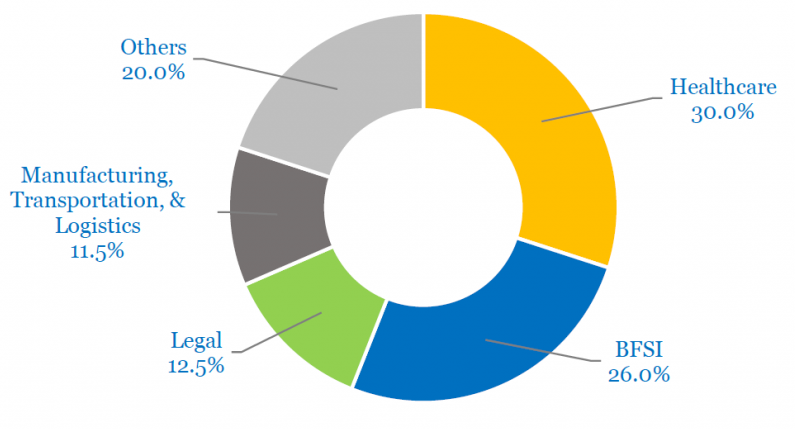
    Several end-user industries are discovering that modern fax solutions are a great way to increase productivity, save cost, and enable a more compliant environment, but none more than the healthcare sector. Ariston reports that healthcare (which includes hospitals, clinics and pharmaceutical companies) is the biggest revenue contributor for fax services, representing 30% of the global market. Healthcare organizations mainly opt for fax services to ensure the secure transmission of patient documents which helps comply with regulatory compliance like HIPAA in the US, not to mention that fax solutions can also automate several document management processes. In coming years, Arizton expects healthcare revenues to continue to grow as fax solutions become more widely used by individual physicians and the use of fax solutions grows in the APAC regions.

    A close runner-up, representing 26% of global revenue for the fax services market is the Banking, Financial services and Insurance (BFSI) sector, with banks and insurance organizations are the leading revenue contributors, followed by mortgage companies. The Arizton report forecasts that by 2022, more organizations in the financial sector are expected to migrate towards hybrid fax solutions. Hybrid fax solutions give companies greater control over their data with on-premise server deployments, yet also offer the flexibility and scalability of cloud fax solutions.

    Looking for a fax solution that can boost productivity, automate workflows, and help your organization meet regulatory compliance no matter what industry you’re in? Contact us.

    The original article can be found here.