Tag: RFTechnology

  • Silence in Critical Care: How Wireless Calling Systems Improve ICU Communication

    The Intensive Care Unit is not just another hospital department. It is where every second matters. Patients are critical, families are anxious and nurses must balance clinical focus with constant coordination.

    In such a sensitive space, communication must be precise and calm.
    The Reality in Many ICUs

    In most hospitals today, when a nurse needs to call a patient’s attendant from the waiting area, the process is surprisingly manual. The nurse informs the security guard outside. The guard then calls out the patient’s name or bed number loudly in the corridor.

    The result?

    Noise. Confusion. Repeated announcements. Emotional tension.

    For families already under stress, this adds to anxiety.

    A Structured and Silent Alternative
    • With a wireless calling system, the process becomes simple and dignified.
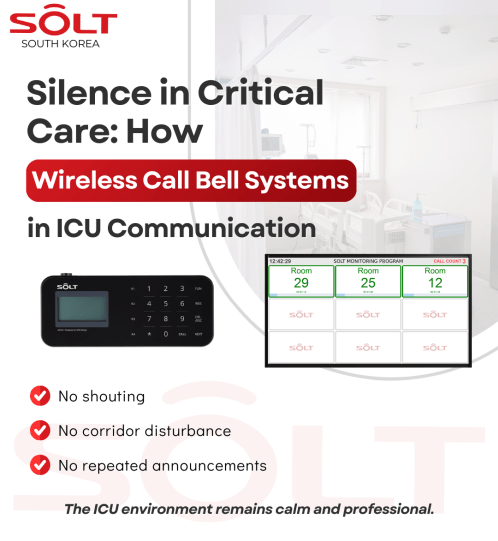
    • From the nurse station keypad, the nurse enters the patient’s bed number. Instantly, that number appears on a display screen in the waiting area. The attendant sees it and proceeds inside.
    • No shouting.
    • No corridor disturbance.
    • No repeated announcements.
    • The ICU environment remains calm and professional.
    Supporting Clinical Workflow
    • Inside the ICU, wireless call points allow nurses to communicate efficiently with support teams. Separate alerts can be configured for housekeeping, maintenance or urgent assistance.
    • The system operates on safe 433 MHz RF technology and does not depend on Wi-Fi networks, ensuring stable communication in critical care areas.
    Faster Installation, Greater Flexibility
    • ICUs are often upgraded in phases. A wireless system avoids the complexity of cabling and civil work. It can be deployed quickly without disrupting patient care.
    • As beds increase or layouts change, the system scales easily.
    The Bigger Picture
    • In the ICU, silence is not just comfort. It is control.

    • Wireless calling systems bring order to communication between nurses, security staff and families. They reduce noise, improve coordination and create a more composed environment during critical moments.

    To modernise ICU communication, call +91 9321064487.
  • Wireless Doesn’t Always Mean WiFi: Why RF is a Better Choice for Nurse Call Systems

    When most people hear the word  wireless, they immediately think of WiFi. It’s what connects our phones, laptops and smart TVs. But in hospitals, when it comes to something as critical as a nurse call system, WiFi might not be the best option.

    That’s where Radio Frequency (RF) technology comes in. While both WiFi and RF operate wirelessly, their use cases and reliability differ significantly—especially in clinical settings.

    What’s the difference?

    WiFi is designed to handle heavy data like video calls, browsing and media streaming. It works on high frequencies like 2.4 GHz and 5 GHz, which can often get congested and interfere with other systems. RF technology used in nurse call systems, typically around 433 MHz, is designed for short, quick, reliable signal transmission—exactly what’s needed in an emergency.

    Why RF is better for nurse call systems
    • Independence from IT networks:  RF systems don’t rely on internet or LAN connections, so they continue working even if the hospital network is down.

    • No interference:  The 433 MHz frequency avoids overlapping with medical equipment and IT systems, making it safe and stable.

    • Reliable coverage:  RF signals penetrate walls and medical infrastructure better than WiFi, ensuring consistent performance.

    • Lower power consumption:  Devices using RF consume less power, making battery-operated systems more durable.

    • Simpler and cost-effective:  RF systems are easy to install without the complexity of routers or cybersecurity concerns.

    Conclusion:

    For hospitals,  wireless doesn’t always mean WiFi. When patient safety depends on quick response times,  RF-based wireless nurse call systems  offer a dependable, low-maintenance solution that just works.