Tag: VoIP

  • Reblog: What is the T.38 Fax Protocol and How is It Used?

    We’ve written extensively about the reasons why fax remains relevant in today’s society from a functional standpoint (widespread systemic adoption within certain industries, privacy regulations, and security), but it can be hard to wrap one’s head around how Fax over IP (FoIP) technology is different from simply uploading and downloading image files from e-mail attachments, file sharing applications, etc.

    The key difference is that fax images are still transmitted as electrical impulses via the phone line rather than files. That makes the core of the technology, even in the age of FoIP, closer to telephony than computer networking.

    Just like Voice over IP (VoIP) technology bypasses large portions of the phone network, FoIP uses IP networks to transmit fax impulses long distances in real time. While full IP transmission is possible, the FoIP data packets are often converted (via a “gateway”) to and/or from traditional phone signals at the beginning or end of their journey to travel some portion via the phones (typically as a local call). Many FoIP solutions use T.38 as their protocol for crossing the IP-based portion of the journey.

    1. How is T.38 FoIP Different than VoIP?


    In terms of their goals and technology, FOIP and VoIP are quite similar, and at least one voice protocol (RTP/G.711) can be used for fax transmission.

    However, some VoIP protocols are balanced for different strengths that can make them less than ideal for FoIP. These protocols are designed to preserve the real-time flow of audio conversation in situations with inconsistent bandwidth, even if they have to drop bits of voice data (typically evidenced by momentary drops in quality like jitter, delay, etc) here and there to do it.

    Given that a fax is being transmitted with the goal of having a complete whole clearly resolved on the other side, this style of omitting compression can cause problems for FoIP.

    T.38 was instead designed with the opposite goal: to preserve the completeness and accuracy of image data, even if it has to use additional bandwidth and time in order to transmit it. In order to do this, there are redundant sections and accuracy checks built into the data streaming in order to make sure everything arrives safely on the other end.

    It’s worth noting that FoIP messages transition to conventional fax protocols (like T.3) if they’re filtered through a gateway and spend time on the conventional phone system. That means that the packet-integrity protections in T.38 only apply while the fax is travelling on the IP network.

    2. Do fax machines use T.38?


    No, most do not. T.38 is generally reserved for fax servers, devices that package faxes in data packets for transmission across IP networks. Traditional fax machines (still in widespread use, despite their drawbacks) and non-FoIP-connected Multifunction Printers (MFPs) rely on traditional phone lines and the fax protocols associated with them (T.3, etc).

    3. How does FoIP save money?


    Traditional faxing has several substantial costs associated with it that FoIP can avoid entirely. Organizations sending & receiving via FoIP can eliminate their fax-dedicated phone lines entirely, dramatically reducing service costs. In addition, because FoIP can be handled by computers rather than fax machines, faxes don’t need to be a physical object. That eliminates the cost of ink, paper, shredding and storage. Finally, fax machines are notoriously unreliable – maintenance and repairs can eat up a lot of IT staff’s time and budget.

    FoIP systems also centralize an organization’s fax processing through a single server that is easier for IT departments to manage, with the various integrated devices and programs sending the faxes (e-mail clients, fax applications, Multifunction Printers, etc) serving merely as points of origin.

    Bring your organization’s document transfer systems into the modern era

    Just because fax is a technology with a history stretching back to the mid-19th century (predating the telephone) doesn’t mean that it has to be clunky today. XMedius offers a cutting-edge FoIP solution that provides all the benefits that have kept fax technology in use (and more!), without the hassles and costs that make traditional fax machines infamous.

    The original article can be found here.

    Reach out to us to learn more about how this technology is saving organizations money, streamlining workflows, and preserving security.

    For more information e-mail us on sales@rincon.co.in and we will be glad to assist you.

  • Reblog: What is the PSTN?

    PSTN stands for the Public Switched Telephone Network – it’s a telecommunications industry term encompassing copper land lines (“POTS”), fiber optics, cellular antennae, satellites and trans-oceanic cables.

    1. What is POTS?

    “POTS” in the telephony world is an acronym for “Plain Old Telephone System”, the modern name for the part of the PSTN made up of old analog copper wire technology. POTS has done the job for decades, but is reaching the end of its usefulness. Modern communications simply require more bandwidth and lower costs than POTS can provide.

    Because of this, analog telephone lines are in the process of being slowly phased out in many developed countries as they transition to more powerful broadband-based communications networks.

    2. What are the advantages of the PSTN?

    When you think about it, the PSTN is one of humanity’s great technological achievements. It gives us the ability to make instantaneous voice connections point-to-point across much of the world, across networks provided by a range of different governments and businesses operating in a variety of different languages.

    A global set of standards mean that any telephonic device can connect with almost any other telephonic device. All you have to do is dial a few numbers, and the network knows exactly where you’re trying to call.

    Because telephone connectivity is considered an essential service in most of the world, governments, businesses, and charitable organizations have gone to considerable trouble to make it as accessible, affordable, and reliable as possible.

    3. What are the disadvantages of the PSTN?

    The primary disadvantage of the PSTN is cost. Maintaining the copper wiring system is time consuming and expensive. The rise of wireless connectivity has led to point-to-point wired connections in general making less sense to install and maintain.

    Business and home telephony is transitioning more and more into VoIP and FoIP technology, as utilizing existing data connections and bandwidth, rather than dedicated phone lines, makes a lot of financial sense.

    The PSTN’s universality is a huge strength, but it also brings with it a notable weakness. Because everything on the network has to work with everything else on the network, across the whole planet, protocols and standards either have to be universally adopted or interoperable to the point where a caller doesn’t have to wait (or lose the call) while their signal crosses from one system to another.

    This can not only lead to increased costs from building in that interoperability, but it also makes change a very time consuming process from a regulatory, roll out, and adoption point of view. The realities of the market can easily interfere with better technology being developed and/or integrated into the system.

    4. What’s the difference between PSTN and VoIP?

    PSTN, Public Switch Telephone Network, POTS, VoIP, Xmedius SolutionsVoIP technology refers to converting vocal communications into data packets and transferring them via internet infrastructure rather than the phone system. VoIP calls can be made between software (i.e. “soft phones”) or physical telephones (“”). If one or more hard phones are involved, it is likely that the phone call at some point has travelled across the PSTN, converted into a normal phone call for at least some distance via network devices known as gateways.

    The use of gateways allows more adaptable and affordable VoIP systems to connect with the more universal and widespread PSTN, giving callers many of the benefits of both. The PSTN portion of the call, with its associated costs, is between the gateway and the recipient’s (or caller’s) phone, which is likely a local call rather than a long distance one. Most of the distance covered is via the internet, where it isn’t a factor in the cost.

    Enhance Your Organization’s Communications with XMedius Solutions

    XMedius offers a range of solutions that can help your business interact with or avoid the PSTN and the Cloud on your own terms. In addition to secure FoIP and file transfer technology, our portfolio also includes CX-E, a top quality Unified Communications platform delivering a suite of applications to companies of all sizes. Reach out to our team to discuss what our technology can do for your organization.

    The original article can be found here.

    For more information e-mail us on sales@rincon.co.in and we will be glad to assist you.

  • Reblog: Are IP Fax Solutions More Economical Than Traditional Fax?

    [image src=”https://www.rincon.co.in/site/wp-content/uploads/2019/02/traditionalfax.jpg” shape=”img-rounded”]


    If your organization is still using traditional phone lines, going with a traditional fax machine can be tempting. The machine itself is relatively affordable, and it can use the phone lines you already have. It’s quite possible that your organization already has a traditional fax setup, which can make the costs of a change seem high relative to just staying put with what you know.

    Unfortunately, several factors make traditional fax machines unsustainable today. The day-to-day costs of ink/toner and paper add up fast. Machines break easily, which not only means they’re out of service, but that you’re paying to fix them.

    1. The hidden cost of Traditional Fax is time

    Employees have to print their document, walk to the machine, then wait for it to send its payload so they can retrieve the original (especially important if it contains data covered under GDPR, HIPAA, SOX, FERPA, or similar laws).

    It’s difficult to tell if an entire fax has been received on the other end, so if they’re doing the sending, they may need to call or email the intended recipient to check. If they’re on the receiving end and document is particularly timely, essential, or private, they may have to coordinate with the sender to make sure they’re standing by the machine ready to catch the document when it comes out.

    That’s a lot of wasted time where staff could instead be doing productive work.

    2. Phone lines are dying

    Reliability and consumable costs aside, one key consideration trumps all others: fax machines will be completely unable to operate in a post-phone line world. That time is coming sooner than you may think, Europe has announced an end date for their traditional phone services, Australia is following suit, and several US carriers are planning on ending installation of new lines.

    Once those lines are no longer supported, traditional fax infrastructure becomes useless. This is already the case for many organizations who have moved or are moving their phone services to a VoIP system (such as a SIP Trunk).

    3. Fax over IP (FoIP) has none of these problems

    Cheaper connections & SIP-friendly

    FoIP can completely sidestep a connection to the conventional phone network, using the internet to get the message out instead. IP connections are dramatically cheaper than traditional phone lines, and have the added benefit of being technology that continues to be useful after the traditional network eventually goes away.

    Save time by faxing from anywhere

    Using a FoIP solution, faxes can be sent from an employee’s desk (via a laptop or desktop) rather than a machine down the hall. Solutions with mobile & web clients can even send faxes from mobile devices like tablets and cell phones, allowing faxes to be sent from anywhere there’s a signal.


    The added benefit of routing faxes through these devices is the security your IT department can put around them. If someone has to log into your machine to see a fax, it’s a lot more secure than a piece of paper sitting in a public tray.


    Skip the ink, toner, and paper

    While you can print out a FoIP document, you don’t have to, when sending or receiving. That means fewer consumable costs, and less paper copies of sensitive documents to file or shred.

    Manage IT how you wish, and subscribe rather than buy

    A good FoIP solution should be available both on-premises and in the Cloud. If maintaining a fax server on site isn’t something your organization would like to take on, Cloud FoIP solutions allow you to handle everything via a SaaS subscription. Prepaid credit systems are also available that allow you to only pay for what you use.


    Decrease Costs and Increase Efficiency with XM Fax

    XM Fax is a cutting-edge FoIP solution that can deliver excellent ROI and dramatically reduce the wasted time and frustration associated with traditional fax. Bring all the benefits listed above to bear on your communications needs to reap the rewards. Reach out to us to learn more about what it can do for your organization’s workflows and bottom line.

    The original article can be found here.

    For more information e-mail us on sales@rincon.co.in and we will be glad to assist you.
  • Reblog:The public switched telephone network (PSTN) is becoming obsolete.

    As has been predicted by telecom operators in the industry for years, the public switched telephone network (PSTN) is becoming obsolete. Multinational telecom companies already have plans in place to phase-out the country’s PSTN and gradually move to an IP-only service. Nationwide rollouts have already begun with telecom giants like Orange in France, Deutsche Telekom in Germany, and Swisscom in Switzerland, to name a few. Europe is not alone in their efforts to phase-out the PSTN; Major Australian telecom companies have already announced their rollout calendars, and providers have been conducting regional testing of all-IP phone services in the US.

    The main reasons for the migration to an IP-based network is that the traditional PSTN model is becoming increasingly expensive to maintain. Not only does it consume massive amounts of energy, but thousands of older model circuit switches still in operation to maintain existing PSTN networks are based on electromechanical technologies that are over 30 years old. Spare parts, when they exist, are very hard to come by and many equipment suppliers are abandoning the technology. When repairs are needed, locating these components or their equivalent can become extremely expensive.

    A major generation gap

    Telecom operators around the world have already been working on replacing time division multiplexing (TDM) technology with IP or SIP trunking solutions for nearly two decades, for example, by building voice over internet protocol (VoIP) on fiber optic infrastructures. On the level of regional infrastructures, however, traditional telephony around the world remains mostly in parallel with that of the 1980’s, which means huge maintenance costs and increasing risks of breakdowns and malfunctions.

    It’s important to note that the migration towards an all-IP service won’t completely cancel out the older generation of technology. The copper network (twisted pair cabling) remains useful in supporting other, now digital forms of telecommunications, such as dedicated link services (or “leased lines”) and xDSL Internet access.

    Why switch to IP? Because it meets all demands

    The Internet’s packet-switching architecture, open standards, non-proprietary protocols, peered networks and digital hardware are a clear improvement over separate, closed analog networks still using older technology.

    For years, phone companies dismissed IP as an inadequate alternative. Carriers of all sizes have now grasped that the Internet is the only option to satisfy the ever-growing demand from consumers and cloud-based services.

    Europe’s IP Network Migration Rollout

    Migration plans are starting to take shape across Europe, with many countries at various phases of implementation. With 200 national telecom operators across the European continent, it’s understandable that complete IP adoption will take time.

    • Orange explains that from Q4 of 2018, telephone lines in mainland France will no longer be built on the analog Switched Telephone Network (PSTN), but on IP technology. All operators will then offer tailored commercial services. By the end of 2018, neither homes or business in France will be able to order analog phone lines on the old model.
    • As of June 2017, Deutsche Telekom had migrated 61% of access lines in Germany and 64% in the Eastern European countries where it holds stake. Macedonia, Slovakia, and Croatia are now all-IP. DT’s rollout plan is set for completion by end of 2018.
    • As of February 2018, Swisscom has successfully transitioned 2 million customers to all-IP services. They estimate that nearly all private customers will have converted to IP by Q4.

    Even though an all-IP future is taking shape, carriers can’t simply “switch-off” existing PSTN networks, even in countries where there are clearly better and cheaper IP alternatives. In many cases, there are decades-old regulations that enforce the continued operation of obsolete analog networks, no matter how many users they have and regardless of costs.

    Implications of an “All-IP” future

    Telecom companies have already had plenty of time to advance their alternative offers, and have been providing solutions that combine fixed and mobile telephony very transparently for years. Many organizations around the world are already operating on a hybrid model. Take businesses, for example, who’ve maintained the same telephone infrastructure for years, but who’ve decided to reap the cost savings benefits of cloud fax solutions. We’re already in the era of a mobile workforce, and many companies are already on-board with the technology of the future, using fully implemented IP phone systems and cloud-based UC solutions that seamlessly link their mobile, email, and data infrastructures.

    IP networks can use packets to transmit voice, data, or video content equally— and for telecom companies, this represents a single network for voice, video, and data. It’s no shock then, that IP technology has already won the telephone network war, just as it won the data war and is also dominating the video war.

    Europe’s bold move toward an all-IP service is setting an example of what’s inevitably to come for the rest of the world. There’s no question that analog is obsolete, it’s only a matter of time before telephony as we know it globally is completely IP based.

    What can organizations do now?

    At this stage, it’s necessary for organizations who want to take the next step (if only partially) to analyze the expectations and needs of different internal departments: management, business units, marketing & communications, etc. Identify various special needs, and where you could benefit from a migration to IP such as videoconferencing, group calls using collaborative tools, secure file exchange, etc.

    There is already a wide variety of choices for all your needs on the market whether you prefer IPBX, on-premise options, or a solution hosted by a service provider through the cloud.

    Are you looking to learn more about IP solutions that can boost workflow, save money and future-proof your telecom infrastructure? Email us: sales@rincon.co.in today about which solution would work best for your specific needs.

    The original article can be found here.

  • Reblog: Fax Server, Less a Luxury, More a Necessity for Any Business

    Technology is revolutionary and each industry is taking benefit of it. Businesses are moving towards the digital revolution. A few tradition are still as important as it was before. Faxing is one of those traditions still having its own importance in businesses and many industries. Still, a few documents such as contracts, legal papers, bills, etc. needs to get faxed as fax has its own legal value. The technology has also paved its way into the faxing to satisfy the business need. The fax server is a technological advancement to make the faxing digitized.

    Fax servers can use the traditional lines or VoIP to send and receive faxes. One of the most widely accepted efaxing technology is FoIP (Fax over IP). It uses the cost-effective and reliable VoIP technology to send the faxes.

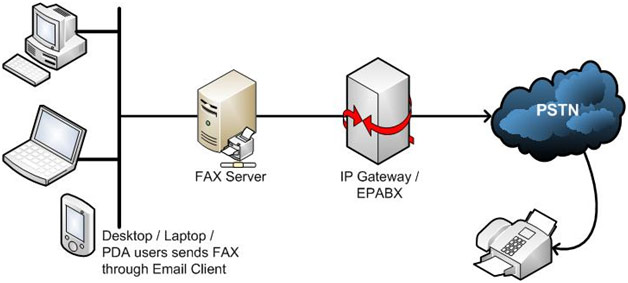
    The fax server converts the documents into the digitized format and send it using the predefined channels. It gets converted into the original format at the receiving end. It can be either printed document or an email based on the configuration.

    Benefits of The Fax Server For Any Business:

    • Reduced Costs
      The fax server reduces the operational cost and stationary required in traditional faxing. It eliminates the papers, toner, and bulky fax machines. It also reduces the maintenance cost required to maintain the traditional machines. The fax servers don’t require any extra hardware or plug-ins to work efficiently, which makes it perfect for any business.
    • Improved Productivity
      The faxing can be performed from anywhere with the FoIP. It eliminates the possible long queues to send the fax from the physical machine. With the fax server, one may easily send the faxes using their desktops, laptops, tablets and even phones.
    • Leveraged Network
      The fax servers eliminate the extra telephone lines required for the fax server. It takes the complete benefit of the existing VoIP network. It also removes the need of extra wiring which makes it more scalable and extensible.
    • 24*7 Availability On Finger Tip
      The fax server can be integrated into the web, software or any mail server based on company’s requirement and choice. It makes it available 24*7 even when you are traveling or on a dinner table. You may send and receive the faxes from anywhere using your simple web or mail servers.
    • Robust Disaster Management
      Majority of the fax servers come with the security configuration. It makes the copy of each or important documents on the server which works as a disaster management. Any time, one can get the backup and recover the lost faxes which is nearly impossible with the traditional fax system.
    • Competitive Edge
      The fax servers give a competitive edge to the business with its advanced features. For example, companies can add their own cover page as a signature of all their documents sent to other firms. It also gives notification once the fax is received by the receiving party. The fax can be auto forwarded in case of failure. It gives a competitive edge to any business.

    There is a plethora of advantages rendered by the fax server software. The modern fax server software has many features which makes it more appropriate compared to the traditional fax machines. It provides the fax templates which can be used to send the faxes of the same nature. One may also block unwanted faxes with ease. The color faxing can never be so easy and cheap as it is with the FoIP software. Any business can use their resources efficiently and improve the productivity by giving their business a professional touch with the fax server software.

    If you are considering implementing a fax management solution for your organisation, but are still sitting on the fence when it comes to selecting the right solution, we encourage you to e-mail us on sales@rincon.co.in and we will be glad to assist you.
  • Reblog: What is Fax over IP?

    Everything is going IP these days. The same is true for businesses across the world.

    From voice to video surveillance systems businesses across the world are migrating their legacy analog systems to those that are IP based. Of course the time tested method for sending and receiving important business documents – fax – is also undergoing this migration

    For years you’ve been able to send and receive faxes over an IP network. But until recently successful faxing over an IP network has escaped many a person.

    What’s changed?

    A lot. However, before we get into that, let’s first take a closer look at Fax over IP.

    What is Fax over IP?

    Fax over IP (also known as FoIP) refers to the method and technology of sending fax documents over an IP network (local or wide area). This is different from the way faxes have traditionally been handled.

    For years the sending and receiving of fax documents has been handled over the PSTN or Publicly Switched Telephone Network. With Fax over IP fax documents by-pass the PSTN completely.

    This is similar to how VoIP (Voice over IP) works, but requires additional network bandwidth due to the increased size of fax documents.

    How does Fax over IP work?

    The concept behind how Fax over IP works is very straight forward (especially if you’re already familiar with how VoIP works).

    With Fax over IP your fax document is first packetized, then encapsulated in a transport protocol and sent from “Point A” to “Point B”. Point A and Point B are typically fax machines which interface with a Fax over IP gateway or some sort of IP adapter.

    These devices allow fax machines to interface with an IP network as well as conduct the digitizing and encapsulating of the fax document.

    Benefits of Fax over IP

    In reading about Fax over IP you might be thinking that Fax over IP simply mimics traditional faxing capabilities.

    While Fax over IP does closely mimic the general set-up and use of traditional faxing it does come with several unique benefits:

    • Unified network connectivity – Fax over IP leverages your existing LAN and WAN IP networks so you don’t have to manage or pay for a separate analog network.
    • Advanced management – Bringing fax documents into IP realm allows for fax documents to be easily archived, sorted and emailed.
    • Lower cost – With one less network to pay for and manage there is a definitive cost saving in using Fax over IP. Fax over IP also tends to be more cost effective on a per-minute rate versus faxing over the PSTN.
    • Remote usage – There are many locations throughout the world in which a fax line cannot be provisioned. In areas such as these individuals typically rely on satellite connections, like satellite Internet, which allows faxing over IP.

    What about Fax over IP being hit or miss?

    Ah yes! Let’s get back to this.

    Due to the nature of IP technology there have traditionally been many hurdles to successfully implementing Fax over IP.

    Like voice, Fax over IP is subject to issues such as latency, packet loss and jitter. With voice calls you can typically deal with these issues as they don’t substantially impact the result of the call.

    But when it comes to faxing anything less than perfect document transmission is unacceptable.

    So what has changed to make Fax over IP 100% reliable?

    Well, much.

    Advances in technology and new offerings from Fax over IP gateway manufacturers have finally made 100% reliable Fax over IP a reality.

    The original article can be found here.

    If you are considering implementing a fax management solution for your organisation, but are still sitting on the fence when it comes to selecting the right solution, we encourage you to e-mail us on sales@rincon.co.in and we will be glad to assist you.