Tag: XMedius

  • Fax over IP (FoIP) software, XM Fax 9.0 – New Version

    We are pleased to announce that the newest version of our popular Fax over IP (FoIP) software, XM Fax 9.0.

    This newest version of XM Fax builds upon the successes of XM Fax 8.0, delivering new features designed to further bolster the security, scalability, and reliability of your customers’ fax environment – all while boosting employee efficiency, especially for those on-the-go.

    Focused on the safe, confidential electronic transmission of data, XMedius has enhanced its XM Fax solution to bring a diverse set of benefits to users and administrators. A few examples include:

    Enhanced Security: Configurable password policies, encryption at rest for fax documents, hardened TLS configurations, and support for TLS 1.3 are new in XM Fax 9.0. Frameworks and third-party libraries have been updated to ensure the highest security standards and long-term support.

    Improved System Integration: Customizable fax properties can be edited at any point in the lifecycle, allowing for additional integrations and workflows. IPv6 support is now available in XM Fax 9.0, enabling seamless integration with various enterprise network types.

    Enriched User Experience: Users can now integrate their web phone book with SendFAX, preview faxes before sending them in the web client, and unlock new XM Fax mobile app capabilities (iOS and Android).

    Augmented Administrative Tooling: Administrators can now take advantage of single sign-on (SSO) in the administration interface, manage fax box delegations on behalf of users, and have better control over OCR management.

    For more information e-mail us on sales@rincon.co.in and we will be glad to assist you.

  • XM Fax Enabling modern businesses to fax documents online

    For several years, XMedius has been offering its customers the most efficient solutions that are constantly optimized to meet the new realities of business’ data transfer requirements. The XM Fax® solutions suite transforms the manual handling of your organization’s inbound and outbound data transmissions into a managed business workflow. XM Fax software solutions are designed and continuously optimized to enhance productivity, streamline operations, and keep companies compliant with ever-increasing regulatory requirements.

    Whether you choose a cloud fax service, software or the best of both worlds, XMedius solutions will exceed your expectations.

    XM Fax On-Premises

    Redefining fax since 2002, XM Fax On-Premises is the XMedius flagship solution to fax documents online. XM Fax On-Premises is highly scalable to meet the growing document exchange needs of organizations of all sizes. Eliminate fax hardware by sending and receiving sensitive documents from an industry-leading fax solution directly from your workstation, multifunction printer, laptop, or mobile device.

    To offer flexible deployment options, XM Fax On-Premises is available in Service Provider, Enterprise, and Express editions.

    XM Fax Cloud

    In addition to reducing costs by eliminating fax machines, ink, and toner, XM Fax Cloud happens to be hosted by one of the most secure hosting infrastructures in the world. The XMedius cloud fax solution deploys rapidly, so you’ll experience virtually no downtime. Sending and receiving your data transmissions through the cloud means no additional hardware or software investments, and no busy signals.

    XM Fax Cloud also offers unlimited scalability and fax capacity, so as your business grows, your eFax solution will grow right alongside it.

    XM Fax Hybrid

    When it comes to choosing a secure file transfer software, XM Fax Hybrid offers the best of both worlds. It leverages the XM Fax Cloud infrastructure to offer a fast, simple deployment while also giving you full control over data storage, location, and ownership. The robust XM Fax Hybrid solution offers high availability and disaster recovery so you can continue to send business-critical data transmissions in the event of outages.


    For more information e-mail us on sales@rincon.co.in and we will be glad to assist you.

  • Data Security – a Look Forward into 2019

    [image src=”https://www.rincon.co.in/site/wp-content/uploads/2019/02/data-security-300×200.jpg” shape=”img-rounded”]


    As the new year begins, we sat down with Executive Vice President and CTO of XMedius, Sébastien Boire-Lavigne, and asked him to consult his crystal ball about what might be the big data security stories waiting to happen in 2019.

    Internet of Things: The Enemy Within

    The proofs of concept have been well established and documented, it is just a question of time before Internet of Things (IoT) attacks will make the next big headline.

    When Alexandru Balan, Chief Security Researcher at Bitdefender, presented at RSA 2018 how a simple smart plug could be exploited, I came to realize how much of a serious blind spot in our information security system IoT devices are in general and how much of a grave danger it is to everyone’s home network.

    “Non computer” devices are often perceived has having a lower risk profile than computers, but that may change fast in the next few months. In his presentation, Alexandru managed to easily discover millions of smart plugs over the Internet using an open API and then proved that the plugs could be infected to establish a persistent foothold to launch attacks from within whatever network they are in. That’s as bad as it gets.

    Don’t be deceived by their appearance, these are fully-operational headless computers. Once infected, IoT devices bypass normal security protections, like firewalls, and allow attackers to start probing network weaknesses and eventually move into systems with valuable information. Most IoT devices run some version of busybox, a Linux distribution targeted for embedded devices.

    So the real danger of IoT is not a hacker flipping on or off your lamps, making you hot in the middle of the summer, or playing some Danish death metal on your smart speaker at 3AM in the night (Ref: episode eps2.0_unm4sk-pt1.tc of Mr Robot), it’s invading your network. Networks are more vulnerable from the inside than from the outside, and this is particularly true for home networks.

    HOW AN IOT HACK COULD HAPPEN

    Imagine this scenario: let’s have a tradeshow booth for our fake company at the Gartner IT Symposium, targeting high-profile IT executives. Let’s give away smart plugs to everybody who gives us their business cards. That way, by carefully giving the smart plugs in a particular order, we can even know who got which plug. Odds are good that they will use the smart plugs at home, which is perfect for us, as there aren’t usually much intrusion detection systems (IDS) running on home networks.

    The end result? For the cost of some smart plugs and a trade show booth, an attack on the CIO or head of IT of a billion-dollar company can be executed from the comfort of his home network. This is an hypothetical attack scenario, but it is certainly not far-fetched and would be fairly easy to implement.

    SO WHERE DOES THAT LEAVE US?

    Realistically it is hard to believe that IoT device manufacturers will harden their $50 devices to the point where they can be trusted. Legislation like California’s “Security of Connected Devices” is certainly a step in the right direction, but frankly it doesn’t change the economic fundamentals of those “cheap headless devices”.

    The only legitimate solution then is a zero trust approach to IoT, IoT devices must be radically segregated from the rest of our networks, both at work and at home. Consumer network manufacturers should start having “default” configurations that include a secure zone explicitly for IoT devices, where they could not be used to attack other valuable assets on the network.

    Note to self: do not install smart cameras in bedrooms…

    Over Proliferation of Security Frameworks and Questionnaires, the Unbearable Cost

    Security framework and security questionnaires have existed for while now, but 2018 is an inflection point. The conjunction of the adoption of the Cloud and the integration of the global IT supply chain is multiplying the requirements for providers running security programs, unfortunately while delivering frankly little benefit to all parties.

    Before, few customers were requiring security certifications, so supporting customer requirements was not too much of a burden and a certification was nice to have. Those days are over, and customers are getting more sophisticated in managing the security requirements of their cloud suppliers. This is actually a good thing, it makes businesses and the internet as a whole a safer place. The problem lies in the multiplication of ad hoc security questionnaires and various security requirements.

    TOO MANY QUESTIONS THAT ARE ALL THE SAME

    Most security questionnaires are asking the same questions, but in different ways. This imposes a heavy cost burden on cloud providers. For example, The Cloud Security Alliance CAIQ questionnaire is certainly a worthy initiative. We spent several weeks filling it out, supplying meaningful answers and thorough notes. We can’t spend that kind of effort on “ad hoc” questionnaires.

    It would be to the benefit of all parties to use a standardized security Q&A system, so that everyone gets the most out of it. Of course, some industries may have specific requirements, but we should be able to construct a modularized approach to questionnaires that build one on each other.

    A FRAMEWORK FOR EVERY PROBLEM

    We’re also seeing the same phenomena with security frameworks. In the last 12 months we have been asked to demonstrate compliance with: SOC2, HIPAA, GDPR, ISO 27001/27017/27018, NIST 800.53, CSA, HiTrust, PCI-DSS, Fedramp, and CIJS. I’m sure there are several more around the corner.

    There is a need to standardize the whole tech industry onto a single global security framework that can be extended into specializations that address particular requirements of specific markets.

    I think that France’s healthcare services provider certification (HDS) is a good example of the right way to establish sectorial certification. They required compliance to ISO 27001, ISO 20000 and ISO 27018 along with 38 additional security controls specific to their sector. This a much sounder approach to the problem than building yet another security framework from A-Z.

    We need a universal security framework. I personally favor ISO 27001 and working on sectorial security control as an extension to the base system. This would significantly reduce effort to support a broad range of certifications, make cyberspace a safer place, so we can spend our time securing information assets instead of demonstrating the same thing over and over again.

    I will not be holding my breath though…

    The Empire Strikes Back… on Encryption

    Encryption. We take it for granted, but the truth is that our privacy and security are under attack, and not by some dangerous hackers, but by our own governments.

    Following the footsteps of the UK government, the Australian government just signed a law (the Telecommunications and Other Legislation Amendment bill) giving law enforcement far reaching rights to compel internet service providers to alter their security protections (i.e. encryption) so law enforcement may gain access to user data.

    While this may sound reasonable, it’s a Pandora’s box that is easy to open, but very difficult to close. Given the way encryption works, it is not possible to weaken it for the government without weakening it for all hostile parties. For example, if companies are forced to roll back end to end encryption and best in class encryption key management practices to allow government to intercept communications, everyone suffers from the weakened security.

    In most cases, the best way to build strong encryption schemes is to make sure that even the maker of that scheme cannot circumvent it. If the NSA was not able to protect “EternalBlue”, which ended up causing several billion dollars in damages around the world, can we really expect that service providers will be able to protect us with weakened encryption systems?

    It doesn’t stop there. In the US, the FBI is lobbying for legislation that would force tech companies to weaken encryption schemes on smart devices, and also fighting in court to force Facebook to weaken the encryption of Whatsapp.

    What do clipper chipskey escrow, backdoor or front door, and lightweight encryption have in common? These are bad schemes that hurt citizen privacy and security with no clear advantage to society. Personal information, healthcare information, and banking information should be protected by the best encryption schemes possible.

    In any case, it is wishful thinking to try to put 100 years of advancement in cryptography science back into its box. Determined parties will have the means to develop and use perfectly secure encryption software, obtained outside normal commercial channels, and keep their communications protected from the prying eye of governments. In contrast, law-abiding citizens will see their day to day activities put at risks for little to no benefits. While that may discomfort governments, encryption is here to stay. In the age of the internet, without encryption there is no freedom and without freedom there is no encryption. Countries restricting access to encryption says a lot on how much they really value the freedom and protection of their citizens.

    It is a battle that the tech industry must continue to fight for the benefit of all.

    Want to be better prepared for the security requirements of 2019?

    XMedius offers cutting edge secure data exchange solutions that can boost protections while facilitating easier compliance with privacy regulations.

    The original article can be found here.

    For more information e-mail us on sales@rincon.co.in and we will be glad to assist you.
  • Reblog: 4 Things You Might Not Know About HIPAA Compliance

    [thumbnail target=”_self” src=”https://www.rincon.co.in/site/wp-content/uploads/2019/01/Healthcare-1024×560.jpg”]

    HIPAA is an incredibly influential part of the US healthcare regulatory landscape. Because its focus is the security of electronic personal information, it’s no surprise that the law and its requirements continue to evolve as the tech landscape changes.

    While this is ultimately a good thing, ensuring that the law makes sense in regards to the resources available and challenges faced in healthcare IT, it can also make HIPAA compliance a bit of a moving target. What doesn’t change, however, is the extreme consequences of a security breach.

    1. It’s Not the Fines That Get You

    A HIPAA breach can deliver a serious blow to your organization’s financials, but the costs may not be coming from where you think. The requirement to publicize that the breach occurred can cause more damage than a government fine.

    [well type=””]

    “If you do the math and you look at an organization that has 10,000 records, that’s between $2 million and $4 million worth of risk. 25,000 records? Up to $10 million in risk. And 100,000 records mean $40 million in risk. Now, I’m saying risk because it’s not the cost of the breach itself. A study shows that about one-third of these numbers is the actual cost of the breach.

    The cost of the breach includes notifying patients and hiring lawyers. If it’s a big breach, you have to set up an 800-number and have people answering it. You may have to do credit monitoring. That’s about a third of these costs. What’s the other two-thirds? It’s the loss of business.”

    Mike Semel

    President & Chief Compliance Officer, Semel Consulting

    [/well]

    2. Inattention is No Excuse, Even If Nothing Bad Happens

    The law requires organizations to secure information from prying eyes, whether those eyes are there or not. Organizations are required to make sure all their systems are properly maintained, even if that means installing a completely new operating system (which may itself require new hardware).

    [well type=””]

    “HIPAA says that you have to have devices that are currently supported with patches and updates in order to be compliant.”

    Mike Semel

    President & Chief Compliance Officer, Semel Consulting

    [/well]

    3. HIPAA Breaches Can Even Come from Within

    It’s important to remember that HIPAA violations aren’t always caused by malicious outsiders, your own employees can be a source of trouble, either intentionally or unintentionally. It’s essential to remember that HIPAA requires only relevant staff have access to any given record. If a nurse looks at the diagnosis for a celebrity staying in another ward, that’s a violation. If your radiology department email’s a patient’s x-ray results to the wrong doctor, that’s a violation.

    Regular training and oversight are key to protecting your organization against threats from within, in addition to keeping bad actors out.

    4. A Key to Better Health Data Security Can Be Simplicity

    Because many data security solutions are cumbersome, it is common for staff to circumvent them by relying on insecure (but more user-friendly) consumer file-exchange solutions instead. The best way to keep this from happening? Make your security rules easier rather than weaker.

    If sending a document via Fax-Over-IP or a secure file exchange solution is as easy as sending an unsecured email, your employees are much more likely to do it. By making proper compliance the path of least resistance, you streamline workflows, reduce staff frustration, and better protect your organization.

    Ready to streamline regulatory compliance with XMedius secure document exchange solutions?

    The original article can be found here.

    For more information e-mail us on sales@rincon.co.in and we will be glad to assist you.
  • Reblog: XMedius Weighs-In on What Recently Revealed “Faxploit” Attack Could Mean for Organizations

    Newly revealed vulnerabilities mean hackers may be able to access sensitive company data via fax line entry points.

    Last week, researchers from Check Point, an Israeli IT security software provider, revealed vulnerabilities in the fax protocol that could serve as entry points for hackers into corporate networks during a talk they gave at the DEF CON 26 security conference in Las Vegas.

    This type of attack, named “Faxploit”, allows hackers to send crafted images to an organization’s fax machine containing code that exploits vulnerabilities, enabling them to take over the machine. From there, hackers can use the fax machine to deploy other hacking tools that scan local networks and compromise nearby devices. In a demonstration given, Check Point specifically took advantage of two buffer overflows in the implementation of fax capabilities in an HP device: CVE-2018-5924 and CVE-2018-5925. Please note that XMediusFAX software is not affected by the specific vulnerabilities that were discovered and used during this exploit.

    It was reported that the above-mentioned vulnerabilities are simple to exploit; hackers would only need an organization’s fax number to target them. The attack code comes in via dedicated fax lines with no internet connection required. Since fax machines don’t come with security software to scan inbound faxes, Faxploit can be difficult to defend against. Most companies publish their fax numbers in plain sight on their websites, and Google has over 300 million fax numbers indexed, making Faxploit a potentially powerful tool for hackers to be able to target almost any organization in the world.

    Not only Fax Machines are Vulnerable

    It’s important to note that Faxploit also targets multifunction printers (MFPs) with built-in faxing capabilities.

    XMedius wishes to advise concerned organizations on steps they can take to minimize risk of a Faxploit attack:

    • If your company sends and receives fax transmissions via MFP, it is important to contact your provider for any available security patches as soon as possible. So far, HP has already responded by releasing patches for their series of HP Officejet all-in-one printers, but many fax machine and MFP vendors could also be vulnerable.
    • A simple method of defense against Faxploit attacks is network segmentation. Breaking larger corporate networks into smaller networks, or isolating fax machines onto their own subnetworks can not only greatly reduce the risk of attack, but also limit scope of personal data that hackers could gain access to.
    • A third option would be to reduce your organization’s possible attack area using centralized fax server solutions instead of hundreds of fax devices spread across your whole network. Centralized fax solutions are easier to protect, update and monitor.

    Your faxing environment needs to be handled with an appropriate level of precaution, just as you do for your mail, your web server or your workstation environments. If your organization is currently using, or is considering migrating to a fax server solution, here are a few elements that should be taken into consideration:

    Reduce the risk footprint:

    • Using a fax server/service solution reduces the number of devices you have to be concerned about and provides a more controllable environment
    • You can still leverage your MFPs with the use of several integrations and connectors from your FoIP provider or its partners, allowing them to have faxing capabilities without being connected to the public telephony network
    • Harden your servers by stopping unnecessary services and reducing the number of unneeded software

    Keep software up-to-date:

    • Keep your fax server OS up-to-date, as you would do for your workstation environment
    • Devices like faxes and MFPs need to be updated to get the latest security fix. This is often an oversight in patching policies.
    • Consider retiring devices that cannot be updated. If vendors no longer offer active support and security fixes, these devices can be a weak link in your overall data security strategy

    Monitor your systems for viruses, trojans and other forms of attacks

    • Use a good antivirus/antimalware and make sure to keep it up to date
    • Use vulnerability scanner tools to detect out-of-date software
    • Monitor traffic coming out of the MFD and fax server zones, a compromised device will create atypical network traffic that can be detected by intrusion detection systems (IDS).

    The original article can be found here.

    For more information on minimizing fax protocol vulnerabilities, e-mail us on sales@rincon.co.in and we will be glad to assist you.

  • Reblog: Are free online fax solutions right for companies?

    Choosing a free online fax solution versus a professional service will depend on an organization needs in terms of security features, customer service, and support.

    With all its advantages, online fax technology is increasingly popular within organizations that need to exchange documents on a regular basis. At the same time, alternatives to the traditional fax have been developed by numerous providers. Some developers even present solutions that they offer free of charge over the Internet. But are these free online fax solutions appropriate for companies?

    Here are a few features that highlight various shortcomings of these free Internet fax programs.

    Free online fax solutions and data security

    As recent news about data breaches and compliance issues will show you, more and more companies need to improve the way they handle personal information about their customers or any other sensitive data that may have a high value for defrauders. It’s clear that data security has become a major issue for many organizations.

    To ensure the confidentiality of documents transmitted online, certain telecommunications companies have developed effective solutions for secure transfer, assuring users that their documents can only be consulted by the intended recipients.

    Procedures such as encryption or transit over highly secure infrastructure can guarantee users of an online fax service that their messages will remain confidential.

    It is also possible that the messages received may be infected by computer viruses. It is therefore a good idea to make sure that the selected service can identify the presence of this kind of threat.

    However, these security features are very rarely a privilege of free online faxing, making them a risky choice for companies that work with sensitive data.

    Performance can differ between free and professional services

    Since each company is different, their communications needs will differ based on factors such as their size and their area of business. For example, some organizations require archiving tools, while others must regularly send large files that exceed email attachment limitations.

    However, free fax services often offer only basic options that do not include long-term storage of documents or the sending of larger files.

    Fax solutions providers, on the other hand, offer solutions tailored to their customer’s needs. Organizations who are looking for specific features, like the ability to transmit larger files, customizable security options, and an audit trail, for example, will find that consulting with fax service providers on the options available to them will work better for them in the long run. Today’s fax solutions come with an assortment of volume-based pricing options, so in the end, organizations only pay for their typical usage.

    Support offered by online fax service providers

    Implementing an online fax service may require technical skills that only specialists possess. For companies that need to send faxes daily, a service interruption can cause significant problems.

    For this reason, companies moving to fax over IP solution should be able to count on support from their service provider. Although free fax solutions usually offer customer service, it is rarely fast, nor would a user be able to get the full support they require.

    With a full-featured online fax solution, the customer obtains the benefits of a technical team and 24/7 customer support. This minimizes the risk that a lengthy service interruption will impact the organization’s activities.

    Online fax solutions from XMedius

    In light of this information, although free online fax solutions may be appropriate for certain users, they can be a risky choice for companies that don’t want to find themselves in an unfortunate situation because of their shortcomings.

    In order to benefit from secure transfers, added features and constant technical support, put your trust instead in a recognized provider like XMedius.

    XMedius is a world leader in the field of secure file transfer solutions for companies. It developed the first all-inclusive fax over IP software in the industry. The services it offers have what it takes to meet the needs of all organizations.

    The original article can be found here.

    For more information e-mail us on sales@rincon.co.in and we will be glad to assist you.

  • Reblog: Information security: is it a critical issue for companies?

    Security incidents related to sensitive information have the potential to negatively impact targeted businesses in a variety of ways.

    In recent years, many global businesses have fallen victim to hacks and been robbed of sensitive information about their customers. The impact of these incidents has the potential to negatively affect the targeted businesses in a variety of ways.

    It is therefore more relevant than ever to wonder whether information security should be a critical issue for companies.

    Here are some lines of thought that indicate it should.

    Information a company possesses can be a competitive advantage

    Anyone who runs a business also owns any information about the business itself. This includes information about the products or services it offers, business and financial plans, as well as information about the buyers of the goods or services.

    Some of this business data is used for risk mitigation, revenue optimization and overall improvement of an organization’s core business. By the mere fact that this data can generate future benefits, it becomes an asset that must be protected from the competition. Any information that can be used to grow a business should therefore remain secure and confidential.

    A sensitive data leak can destroy a company’s reputation

    Most companies aim to sell goods or services. Customers transmit sensitive information to them, even with a simple one-time purchase using a credit card. Of course, no serious company would intentionally abuse personal information about its customers. However, a simple unintentional data leak could easily affect their reputation.

    Personal information leaks and security breaches pose a real threat to businesses of all sizes. Moreover, when they happen, there is more than just money at stake. Imperfect data security puts all your customers at risk, and therefore the future of the business as well. Indeed, a good reputation takes years to build while it can be destroyed in just a few seconds.

    More and more governments are putting laws in place to ensure information security

    In addition to negatively affecting a company’s reputation, a leak of sensitive customer information can also have legal and financial ramifications. Many governments now have legislation that holds organizations accountable for the personal data they possess. Those found guilty of negligence at this level can face severe penalties.

    The European Union’s GDPR (General Data Protection Regulation) is a good example. Employed in Europe since 2018, its mission is “to give citizens control over their personal data, while simplifying the regulatory environment for businesses”.

    Get the best advice on data security

    For a company, ensuring perfect data security is no easy goal. However, compared to the undesirable consequences of an information leak, it is certainly worth considering information security as an important issue and securing your business data.

    To support organizations in adopting safe practices when sharing or storing sensitive data, XMedius offers tailored support to meet the specific needs of numerous industries.

    The original article can be found here.

    For more information e-mail us on sales@rincon.co.in and we will be glad to assist you.

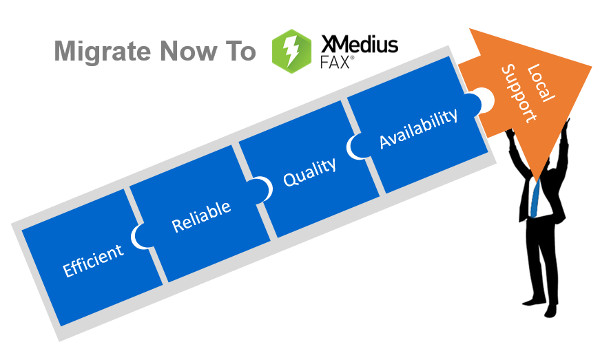
  • Migrating your Fax Server to XMEDIUSFAX

    Fax-over-IP is a critical component in the communications infrastructure of many organizations. It is optimized to secure and streamline their document workflows, and it helps them to achieve compliance with the security and privacy regulations that apply to their respective industry sectors.

    XMediusFAX® is an ideal FoIP solution. It is a single-source, software-only technology and includes its own patented T.38 protocol, the most reliable protocol for transmitting faxes over a VoIP network. Better yet, XMediusFAX® doesn’t require a third party to enable your fax infrastructure and our R&D team has fully mastered the software and can intervene quickly if any assistance is needed. Furthermore, XMediusFAX® features shared High Availability (HA) channels that replicate information in real time. Both of its servers are active, so should one fail, the other takes over until the malfunctioning server resumes its normal workload. This ensures an uninterrupted workflow.

    Because of all these critical benefits, the XMediusFAX® solution attracts a range of organizations that are interested in implementing a superior FoIP solution.

    However, switching over from another solution can raise some concerns. One that prospective customers most often express involves migrating and preserving their existing data. In response to this concern, the XMedius team has developed a tool to help our new customers migrate from their current database* to an XMediusFAX® server while preserving all of their fax records and user information.

    Would you like more information about the migration offer of your current Fax-over-IP solution to ours?

    *Conditions Apply

    E-mail us on sales@rincon.co.in for more information and we will be glad to assist you.
  • Reblog – Data Security In Education: What IT Professionals Need To Know

    How adopting Fax-over-IP technology can help participants in the educational sector meet their various legal obligations.

    Educational institutions, from primary schools to universities, send and receive important and confidential documents every day. And because significant volumes of highly sensitive data are exchanged, security threats are an ever-growing problem. As a result, data security has become a primary concern.This infographic illustrates why the transmission of information by fax is a critical component of an efficient and secure information system, and how adopting Fax-over-IP technology can help participants in the educational sector meet their various legal obligations.

    xmedius_blogimage

    The original post appears on the Xmedius.com website and is available here.

  • Sagemcom unveils its new version XMediusFAX 7.5

    November 19, 2013

    Sagemcom, the global leader in advanced IP fax server solutions, supporting the T.38 FoIP since 2002, is delighted to announce XMediusFAX® 7.5.

    In addition of its interoperability with the T.38 Fax Relay, XMediusFAX® can now transmit faxes with the G.711 Pass-through with Encrypted Fax Transmission protocol (SRTP). The 7.5 release of XMediusFAX® also offers new eCopy ShareScan and Sharp OSA XMediusFAX® connectors for Multifunction Devices (MFDs).

    To view the complete press release click here.
