Tag: Fax

  • Adding value to your HP MFP sales

    Reduce Costs And Enhance Security By Faxing From HP MFPs

    • Still, using fax kits for faxing from HP MFPs?
    • Still, using decentralised faxing using MFPs?
    • Looking for a solution for HP Workpath-enabled MFPs?

    Look no further. We have a solution that delivers a host of business benefits, including improved employee efficiency, streamlined workflows, and a steep reduction in the total cost of ownership (TCO) over traditional fax.

    We have solutions tailored for different-sized organisations, as well as a Cloud version that is flexible and scalable to suit organizations of any size.

  • Do Faxes Cost Your Organisation?

    How much does each fax cost your organization?
    Think again! You are in for a rude shock!

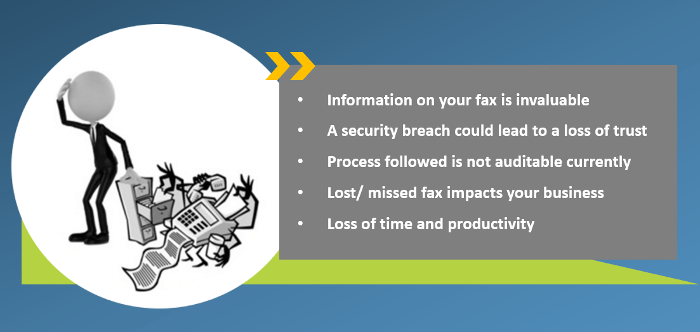
    • Information on your fax is invaluable
    • A security breach could lead to a loss of trust
    • The process followed is not auditable currently
    • Lost/missed fax impacts your business
    • Loss of time and productivity
  • Fax over IP (FoIP) software, XM Fax 9.0 – New Version

    We are pleased to announce that the newest version of our popular Fax over IP (FoIP) software, XM Fax 9.0.

    This newest version of XM Fax builds upon the successes of XM Fax 8.0, delivering new features designed to further bolster the security, scalability, and reliability of your customers’ fax environment – all while boosting employee efficiency, especially for those on-the-go.

    Focused on the safe, confidential electronic transmission of data, XMedius has enhanced its XM Fax solution to bring a diverse set of benefits to users and administrators. A few examples include:

    Enhanced Security: Configurable password policies, encryption at rest for fax documents, hardened TLS configurations, and support for TLS 1.3 are new in XM Fax 9.0. Frameworks and third-party libraries have been updated to ensure the highest security standards and long-term support.

    Improved System Integration: Customizable fax properties can be edited at any point in the lifecycle, allowing for additional integrations and workflows. IPv6 support is now available in XM Fax 9.0, enabling seamless integration with various enterprise network types.

    Enriched User Experience: Users can now integrate their web phone book with SendFAX, preview faxes before sending them in the web client, and unlock new XM Fax mobile app capabilities (iOS and Android).

    Augmented Administrative Tooling: Administrators can now take advantage of single sign-on (SSO) in the administration interface, manage fax box delegations on behalf of users, and have better control over OCR management.

    For more information e-mail us on sales@rincon.co.in and we will be glad to assist you.

  • Reblog: How Can an Audit Trail Help Law Firms Protect Client Interests?

    Sharing legal documentation can be a tricky, but vital, aspect of virtually any legal firm’s business. Legal firms need to deliver documents to clients, the courts, and other concerned parties in a timely manner. Their delivery methods must also take special care to avoid accidentally sharing information with unintended parties as to avoid an accidental breach of attorney-client privilege.

    In the past, when a legal firm needed to ensure proper delivery of documents to a specific party, they would typically hire a process server to physically hand deliver documents. This has typically been considered the best way to securely deliver documents and prove they were received by the intended party. The drawback of this method is that it can be time consuming and very costly, especially if the process server encounters difficulty delivering the documents.

    SHARING INFORMATION VIA EMAIL: DANGEROUS FOR EVERYONE

    For more routine document sharing, such as an attorney sharing court documents with a client or internally with other attorneys, many legal firms find themselves leaning on email and file sharing services. Email, as a rule, should never be used to share sensitive files of any kind. While emailing files is a quick way to share information, someone monitoring traffic in and out of a firm’s IT environment may be able to see the contents.

    The risk of information being accidentally emailed or shared with unintended parties is also a reason to avoid emailing sensitive files. To illustrate the point, according to the Australian government’s Notifiable Data Breaches Quarterly Statistics Report in May 2019, human error was in general, the cause of 31% of breaches in Australia; the second most common reason overall (the first being malicious or criminal attack at 61% of all breaches). The most common error made was sending personal information to the wrong recipient, accounting for 31% of all breaches caused by human error. The second most common error was unauthorized disclosure of information through an unintended release or publication (including online), which could include files inadvertently forwarded to an unintended party.

    Of the malicious and criminal attacks, 5% were caused by social engineering, including email-based executive fraud. All of these factors make sharing files via email an especially risky policy.

    SHARING INFORMATION VIA EMAIL: ESPECIALLY DANGEROUS FOR LAW FIRMS

    If these numbers weren’t daunting enough, the law sector-specific statistics are even worse. While the percentage of breaches caused by human error remains consistent (approximately 34% of legal sector breaches were caused by human error, versus 31% across all industries), 62.5% of those were caused by personal information being emailed to the wrong recipient. Add in the percentage of breaches through unauthorized disclosures, assuming the information was disclosed via email, and that brings the total to 75% of all breaches caused by human error.

    Put another way, during the first quarter of 2019, potentially up to 75% of Australian legal sector breaches caused by human error could have been prevented simply by avoiding the use of email.

    MOST FILE SHARING SERVICES AREN’T MUCH BETTER

    File sharing services may seem like an obvious solution; they are simple to set up and it’s easy to invite relevant parties to collaborate and share documents. The truth is, these types of services frequently lack adequate security (such as two-factor authentication) and retention policies. Additionally, if permissions are not properly set up, it may be possible for collaborators to invite others or share a direct link to the files with unintended parties. These services also often lack detailed auditing functionalities that can decisively prove documents were properly delivered to their intended recipient, nor do they record who actually accessed and downloaded files. What may be the most significant problem is the lack of retention policy controls. File sharing services frequently require files be manually deleted, which can lead to old files remaining in a shared folder well past when is necessary.

    FAX IS BETTER, BUT LIMITED

    Sending documents via fax remains a popular way to securely transfer documents as it is very difficult to intercept faxes in transit. There are a few drawbacks of using traditional fax solutions, however. One is that there can be a risk of unintended parties viewing the files, such as if there is one central, office-wide fax machine. Another is that fax can only support transferring printed documents (no audio or video) and may have constraints on the number of pages that can be faxed based on the memory of the machine receiving the fax (analog fax machines commonly have 64 MB of memory). There often will be a delivery confirmation feature with fax, but in the event the fax is being sent to an office-wide fax machine, there is no real way to tell who has actually looked at the document.

    BUT HOW CAN AN AUDIT TRAIL ACTUALLY HELP?

    A detailed audit trail can make a huge difference in protecting the sanctity of attorney-client privilege, ensuring the proper delivery of legal documents, and holding individuals accountable.

    The original article can be found here.

    E-mail us on sales@rincon.co.in and we will be glad to assist you.

  • Reblog: How should you choose the most suitable online fax service for your company?

    Online fax services offer the possibility to send and receive faxes via an email account, recording them in a digital format. Because of the undeniable advantages of such a telecommunication service compared to traditional fax, more and more companies are turning to this modern solution. But how can you choose the best service and the right supplier?

    Here are some tips for choosing the most suitable online fax service for your company:

    1. Assessing your fax sending and receiving needs

    To select an online fax service, it is essential to assess your needs for sending and receiving faxes. For example, an organization that only sends a small number of faxes per day should consider a pay-as-you-go credit system. In contrast, a company that receives and sends large amounts of documents via every day should instead opt for a fixed-price service, including a high or unlimited number of transmissions. Security issues must also be considered; it will be necessary to know whether need to be protected by effective identification and encryption mechanisms.

    2. Seek advice from other companies in your business sector

    Another good strategy for choosing an online fax service is to search for information from organizations in the same industry sector. Through conversation with organizations that have similar needs, you can discover what functions of Internet fax are practical, essential or superfluous. Sometimes, a business partner will even be able to provide an idea of the cost he is paying for his package, which makes it easier to compare the prices of different suppliers in addition to their service offerings.

    3. Contact a few online fax service providers

    With information and recommendations collected from other companies in the same industry, it is much easier to prepare a list of a few vendors that offer an online fax service with the desired functionality (security, compatibility with mobile devices, etc.). Contacting these companies offers the opportunity to obtain more details about the options and features included in their packages. It is also a good way to test the service quality of sellers, who should take the time to ask you questions to better understand your needs and make you an offer tailored to them.

    4. Evaluate customer service of potential suppliers

    It is always best to ensure the quality of a supplier’s customer service before problems arise. Are agents able to offer 24/24 professional support? An online fax provider whose customer service is reputable should be given extra weight when making your decision.

    The original article can be found here.

    For more information e-mail us on sales@rincon.co.in and we will be glad to assist you.
  • XM Fax Enabling modern businesses to fax documents online

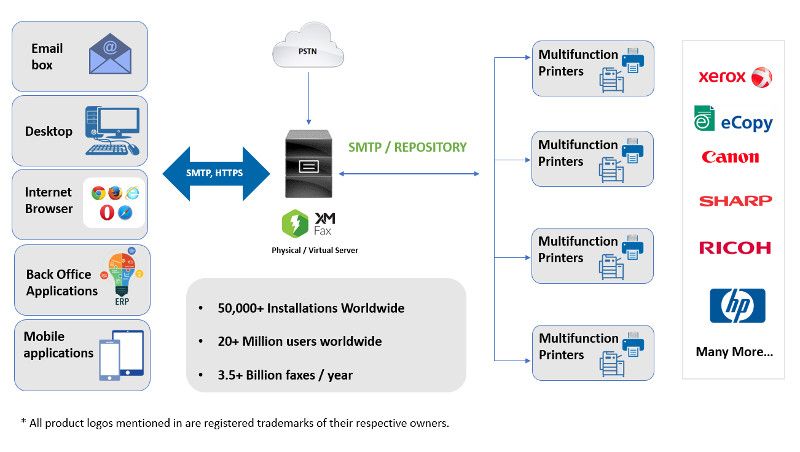
    For several years, XMedius has been offering its customers the most efficient solutions that are constantly optimized to meet the new realities of business’ data transfer requirements. The XM Fax® solutions suite transforms the manual handling of your organization’s inbound and outbound data transmissions into a managed business workflow. XM Fax software solutions are designed and continuously optimized to enhance productivity, streamline operations, and keep companies compliant with ever-increasing regulatory requirements.

    Whether you choose a cloud fax service, software or the best of both worlds, XMedius solutions will exceed your expectations.

    XM Fax On-Premises

    Redefining fax since 2002, XM Fax On-Premises is the XMedius flagship solution to fax documents online. XM Fax On-Premises is highly scalable to meet the growing document exchange needs of organizations of all sizes. Eliminate fax hardware by sending and receiving sensitive documents from an industry-leading fax solution directly from your workstation, multifunction printer, laptop, or mobile device.

    To offer flexible deployment options, XM Fax On-Premises is available in Service Provider, Enterprise, and Express editions.

    XM Fax Cloud

    In addition to reducing costs by eliminating fax machines, ink, and toner, XM Fax Cloud happens to be hosted by one of the most secure hosting infrastructures in the world. The XMedius cloud fax solution deploys rapidly, so you’ll experience virtually no downtime. Sending and receiving your data transmissions through the cloud means no additional hardware or software investments, and no busy signals.

    XM Fax Cloud also offers unlimited scalability and fax capacity, so as your business grows, your eFax solution will grow right alongside it.

    XM Fax Hybrid

    When it comes to choosing a secure file transfer software, XM Fax Hybrid offers the best of both worlds. It leverages the XM Fax Cloud infrastructure to offer a fast, simple deployment while also giving you full control over data storage, location, and ownership. The robust XM Fax Hybrid solution offers high availability and disaster recovery so you can continue to send business-critical data transmissions in the event of outages.


    For more information e-mail us on sales@rincon.co.in and we will be glad to assist you.

  • Reblog: What is the T.38 Fax Protocol and How is It Used?

    We’ve written extensively about the reasons why fax remains relevant in today’s society from a functional standpoint (widespread systemic adoption within certain industries, privacy regulations, and security), but it can be hard to wrap one’s head around how Fax over IP (FoIP) technology is different from simply uploading and downloading image files from e-mail attachments, file sharing applications, etc.

    The key difference is that fax images are still transmitted as electrical impulses via the phone line rather than files. That makes the core of the technology, even in the age of FoIP, closer to telephony than computer networking.

    Just like Voice over IP (VoIP) technology bypasses large portions of the phone network, FoIP uses IP networks to transmit fax impulses long distances in real time. While full IP transmission is possible, the FoIP data packets are often converted (via a “gateway”) to and/or from traditional phone signals at the beginning or end of their journey to travel some portion via the phones (typically as a local call). Many FoIP solutions use T.38 as their protocol for crossing the IP-based portion of the journey.

    1. How is T.38 FoIP Different than VoIP?


    In terms of their goals and technology, FOIP and VoIP are quite similar, and at least one voice protocol (RTP/G.711) can be used for fax transmission.

    However, some VoIP protocols are balanced for different strengths that can make them less than ideal for FoIP. These protocols are designed to preserve the real-time flow of audio conversation in situations with inconsistent bandwidth, even if they have to drop bits of voice data (typically evidenced by momentary drops in quality like jitter, delay, etc) here and there to do it.

    Given that a fax is being transmitted with the goal of having a complete whole clearly resolved on the other side, this style of omitting compression can cause problems for FoIP.

    T.38 was instead designed with the opposite goal: to preserve the completeness and accuracy of image data, even if it has to use additional bandwidth and time in order to transmit it. In order to do this, there are redundant sections and accuracy checks built into the data streaming in order to make sure everything arrives safely on the other end.

    It’s worth noting that FoIP messages transition to conventional fax protocols (like T.3) if they’re filtered through a gateway and spend time on the conventional phone system. That means that the packet-integrity protections in T.38 only apply while the fax is travelling on the IP network.

    2. Do fax machines use T.38?


    No, most do not. T.38 is generally reserved for fax servers, devices that package faxes in data packets for transmission across IP networks. Traditional fax machines (still in widespread use, despite their drawbacks) and non-FoIP-connected Multifunction Printers (MFPs) rely on traditional phone lines and the fax protocols associated with them (T.3, etc).

    3. How does FoIP save money?


    Traditional faxing has several substantial costs associated with it that FoIP can avoid entirely. Organizations sending & receiving via FoIP can eliminate their fax-dedicated phone lines entirely, dramatically reducing service costs. In addition, because FoIP can be handled by computers rather than fax machines, faxes don’t need to be a physical object. That eliminates the cost of ink, paper, shredding and storage. Finally, fax machines are notoriously unreliable – maintenance and repairs can eat up a lot of IT staff’s time and budget.

    FoIP systems also centralize an organization’s fax processing through a single server that is easier for IT departments to manage, with the various integrated devices and programs sending the faxes (e-mail clients, fax applications, Multifunction Printers, etc) serving merely as points of origin.

    Bring your organization’s document transfer systems into the modern era

    Just because fax is a technology with a history stretching back to the mid-19th century (predating the telephone) doesn’t mean that it has to be clunky today. XMedius offers a cutting-edge FoIP solution that provides all the benefits that have kept fax technology in use (and more!), without the hassles and costs that make traditional fax machines infamous.

    The original article can be found here.

    Reach out to us to learn more about how this technology is saving organizations money, streamlining workflows, and preserving security.

    For more information e-mail us on sales@rincon.co.in and we will be glad to assist you.

  • Reblog: Are IP Fax Solutions More Economical Than Traditional Fax?

    [image src=”https://www.rincon.co.in/site/wp-content/uploads/2019/02/traditionalfax.jpg” shape=”img-rounded”]


    If your organization is still using traditional phone lines, going with a traditional fax machine can be tempting. The machine itself is relatively affordable, and it can use the phone lines you already have. It’s quite possible that your organization already has a traditional fax setup, which can make the costs of a change seem high relative to just staying put with what you know.

    Unfortunately, several factors make traditional fax machines unsustainable today. The day-to-day costs of ink/toner and paper add up fast. Machines break easily, which not only means they’re out of service, but that you’re paying to fix them.

    1. The hidden cost of Traditional Fax is time

    Employees have to print their document, walk to the machine, then wait for it to send its payload so they can retrieve the original (especially important if it contains data covered under GDPR, HIPAA, SOX, FERPA, or similar laws).

    It’s difficult to tell if an entire fax has been received on the other end, so if they’re doing the sending, they may need to call or email the intended recipient to check. If they’re on the receiving end and document is particularly timely, essential, or private, they may have to coordinate with the sender to make sure they’re standing by the machine ready to catch the document when it comes out.

    That’s a lot of wasted time where staff could instead be doing productive work.

    2. Phone lines are dying

    Reliability and consumable costs aside, one key consideration trumps all others: fax machines will be completely unable to operate in a post-phone line world. That time is coming sooner than you may think, Europe has announced an end date for their traditional phone services, Australia is following suit, and several US carriers are planning on ending installation of new lines.

    Once those lines are no longer supported, traditional fax infrastructure becomes useless. This is already the case for many organizations who have moved or are moving their phone services to a VoIP system (such as a SIP Trunk).

    3. Fax over IP (FoIP) has none of these problems

    Cheaper connections & SIP-friendly

    FoIP can completely sidestep a connection to the conventional phone network, using the internet to get the message out instead. IP connections are dramatically cheaper than traditional phone lines, and have the added benefit of being technology that continues to be useful after the traditional network eventually goes away.

    Save time by faxing from anywhere

    Using a FoIP solution, faxes can be sent from an employee’s desk (via a laptop or desktop) rather than a machine down the hall. Solutions with mobile & web clients can even send faxes from mobile devices like tablets and cell phones, allowing faxes to be sent from anywhere there’s a signal.


    The added benefit of routing faxes through these devices is the security your IT department can put around them. If someone has to log into your machine to see a fax, it’s a lot more secure than a piece of paper sitting in a public tray.


    Skip the ink, toner, and paper

    While you can print out a FoIP document, you don’t have to, when sending or receiving. That means fewer consumable costs, and less paper copies of sensitive documents to file or shred.

    Manage IT how you wish, and subscribe rather than buy

    A good FoIP solution should be available both on-premises and in the Cloud. If maintaining a fax server on site isn’t something your organization would like to take on, Cloud FoIP solutions allow you to handle everything via a SaaS subscription. Prepaid credit systems are also available that allow you to only pay for what you use.


    Decrease Costs and Increase Efficiency with XM Fax

    XM Fax is a cutting-edge FoIP solution that can deliver excellent ROI and dramatically reduce the wasted time and frustration associated with traditional fax. Bring all the benefits listed above to bear on your communications needs to reap the rewards. Reach out to us to learn more about what it can do for your organization’s workflows and bottom line.

    The original article can be found here.

    For more information e-mail us on sales@rincon.co.in and we will be glad to assist you.
  • Reblog: A slice from Evelyne’s life, executive assistant in a hospital specializing in cardiology

    In my work, I interact with many institutions in the health sector. I meet and have discussions with people who handle a great deal of medical information. I take the time to learn about their daily lives. I enjoy it when they share their experiences and stories with me.

    [row]
    [column lg=”6″ md=”12″ sm=”12″ xs=”12″ ]
    [thumbnail target=”_self” src=”https://www.rincon.co.in/site/wp-content/uploads/2019/01/Hospital-300×200.jpg”]
    [/column]
    [column lg=”6″ md=”12″ sm=”12″ xs=”12″ ]

    Evelyne held a number of positions in various hospitals (in health care and economic services) before becoming Executive Assistant in a hospital specializing in cardiology. She quickly discovered that the hospital had to manage a large number of fax documents of all types (medical notifications, insurance case takeovers, analyses results, care sheets, history certificates, intervention approvals, radiology reports, various test requests or results, purchase orders, invoices, etc.).
    [/column]
    [/row]

    It became increasingly difficult to handle them effectively. Many documents were lost and others were sent to the wrong recipient or forgotten near the fax machine in full view of everyone. With such a volume of documents piled up in the filing cabinets, searching for a fax was lengthy and tedious.

    It was then that Evelyne remembered that the hospital where she had worked a few years prior used a fax software solution instead of traditional fax machines. Showing initiative, she decided to talk to the hospital IT director about it. Aware of the problems associated with the processing of documents sent and received by fax, he dealt with the problem. He quickly approved the idea of replacing the fax machines and fax boards by a software solution.

    This is how the XM Fax® solution was adopted, to the great delight of Evelyne, her co-workers, the IT department and management.

    Evelyne can now send and receive faxes from her work station, her messaging device and her electronic medical records. The processing of faxed documents has thus become much faster and she saves a lot of time. She no longer goes to fax machines many times per day. Evelyne is more productive and effective. She can focus on her mission, which is to provide quality services to patients and to ensure the absolute confidentiality of their personal information. Incoming faxes are now forwarded to the correct recipient without any human intervention, thus limiting unauthorized viewings of health-related personal medical information by the wrong person. With XM Fax, confidential documents of various types are routed to mailboxes or network folders belonging to approved recipients and to designated secure printers.

    As for the IT director, in addition to optimizing his telephone and IP network, it has drastically reduced his expenses related to the use of fax equipment (fax machines, fax boards, maintenance, ink, paper, and telephone lines), and has made it possible to better control the flow and security of communicating by fax. His team is now equipped to administer, monitor and track all the operations and actions carried out in connection with fax transmissions. She can avoid any unauthorized viewings, including those carried out by the administrators themselves, create audit trails, and report to the hospital management. Furthermore, since the hospital is equipped with a high availability redundant fax solution, service continuity is assured. In addition, the advanced and integrated control features of the fax server, the encryption, and the management for users/administrators, meet the requirements of the medical sector in terms of security and compliance. This solution is gaining popularity within hospitals in expansion. Fortunately, this system is scalable to handle a larger volume of faxes and thus serve more departments and employees.

    Today, thanks to Evelyne’s initiative, the hospital is optimizing its unified communications infrastructure, reducing its costs, and increasing the productivity of its employees. Above all, the healthcare organization is now able to process its patient records quickly and in a completely secure manner.

    This truly inspiring account proves to me that any person, no matter his or her hierarchical position, can influence the course of events within the organization in a positive way.

    The original article can be found here.

    For more information e-mail us on sales@rincon.co.in and we will be glad to assist you.
  • Reblog: The enduring appeal of fax -Why it refuses to go away

    As different forms of business to business communication have come and gone over the years, there is one which refuses to go away. In fact, for many industry sectors, it continues to be an essential channel of communication.

    Time and time again, we’ve read articles predicting its final demise.

    Yet fax continues to hold its own, surviving and thriving in certain sectors where other forms of communication don’t provide the same level of simplicity, proof of delivery or, in some cases, levels of security.

    Anecdotal evidence from Japan is that faxing is still very common, and that virtually every office and workplace is equipped with the ability to send and receive faxes. Faxing is still in use for everyday communications such as replying to party invitations.

    We should add at this point that Japan is a special case, with a complex alphabet which makes hand writing messages preferable on many occasions. Perhaps there is even a cultural attachment to the personal aspect of sending a fax, but even so, evidence of the enduring qualities of fax comes from around the world.

    A 2017 survey of German companies with at least 20 employees found that:

    • 70% of respondents said they sent fax messages ‘often’ or ‘very often’
    • Amongst businesses with less than 50 employees, this figure rose to 77%

    The message is clear – if you want to do business with Germany or Japan, you need to include fax in your mix of communications channels.

    Yet this phenomenon is not confined to just these countries. A 2017 IDC (International Data Corporation) survey of senior decision makers in financial services, healthcare, government and manufacturing, across North America, Western Europe and Asia Pacific, found that the use of faxes was actually on the rise.

    • 82% of respondents had seen their use of faxes rise or stay the same compared with the previous year
    • The volume of faxes being sent had risen by 27%
    • Across the 3 regions, the average predicted growth in fax volume over the next 2 years was 25%

    Whilst it might be assumed that the healthcare and legal sectors make more use of faxes due to the paper trail they leave, the projected growth was spread across all sectors:

    • Finance – 20%
    • Healthcare – 25%
    • Government – 27%
    • Manufacturing – 29%

    Other reasons for the ongoing global appeal of faxing are varied:

    Compliance

    Sectors such as healthcare, legal, finance and government demand high levels of data and communications compliance, for example in maintaining a clear paper trail for certain processes and transactions.

    Many jurisdictions only accept signatures on faxed documents as being legally binding, and the fact that sending a fax produces an instant acknowledgement and record of receipt, contributes to the sense of reliability as a communications medium.

    Simplicity

    The simplicity of faxing is also an advantage in sectors such as manufacturing, when getting the right documents signed by the right people in a hurry is frequently advantageous.

    Many businesses still rely on keeping individual copies of receipts, invoices and contracts, and faxing is still the simplest means of ensuring that papers such as these go to exactly the right person, without being lost amongst the avalanche of emails received on a daily basis.

    Security

    Across all sectors, the security offered by faxing can be a huge advantage.

    Faxes can’t be tampered with once sent; nor can they carry a hidden virus.

    This advantage was underlined when Sony Pictures suffered an embarrassing cyber-attack in 2014, during which thousands of private emails were published online. In 2016, the chief executive of Sony, Michael Lynton, revealed that in response to the attack, he now writes out sensitive messages by hand and sends them by fax.

    The handwritten approach may seem a bit over the top for some, but the security and peace of mind offered by faxing is clear.

    In summary

    Fax remains a vital component of business communications across many industries. The benefits fax provides ensures its enduring appeal as a communications vehicle, that other comm’s methods such as email simply can’t match.

    Our ever-popular Zetafax network fax solution continues to meet on-going demand, offering the advantages of faxing combined with the flexibility of online hosting. It is used by more than 65,000 customers worldwide and improves on manual faxing through factors such as:

    • Cost cutting automation
    • Automated archiving
    • Support for Fax over Internet Protocol (FoIP)
    • Integration with other applications

    For more information e-mail us on sales@rincon.co.in and we will be glad to assist you.

    The original article can be found here.